

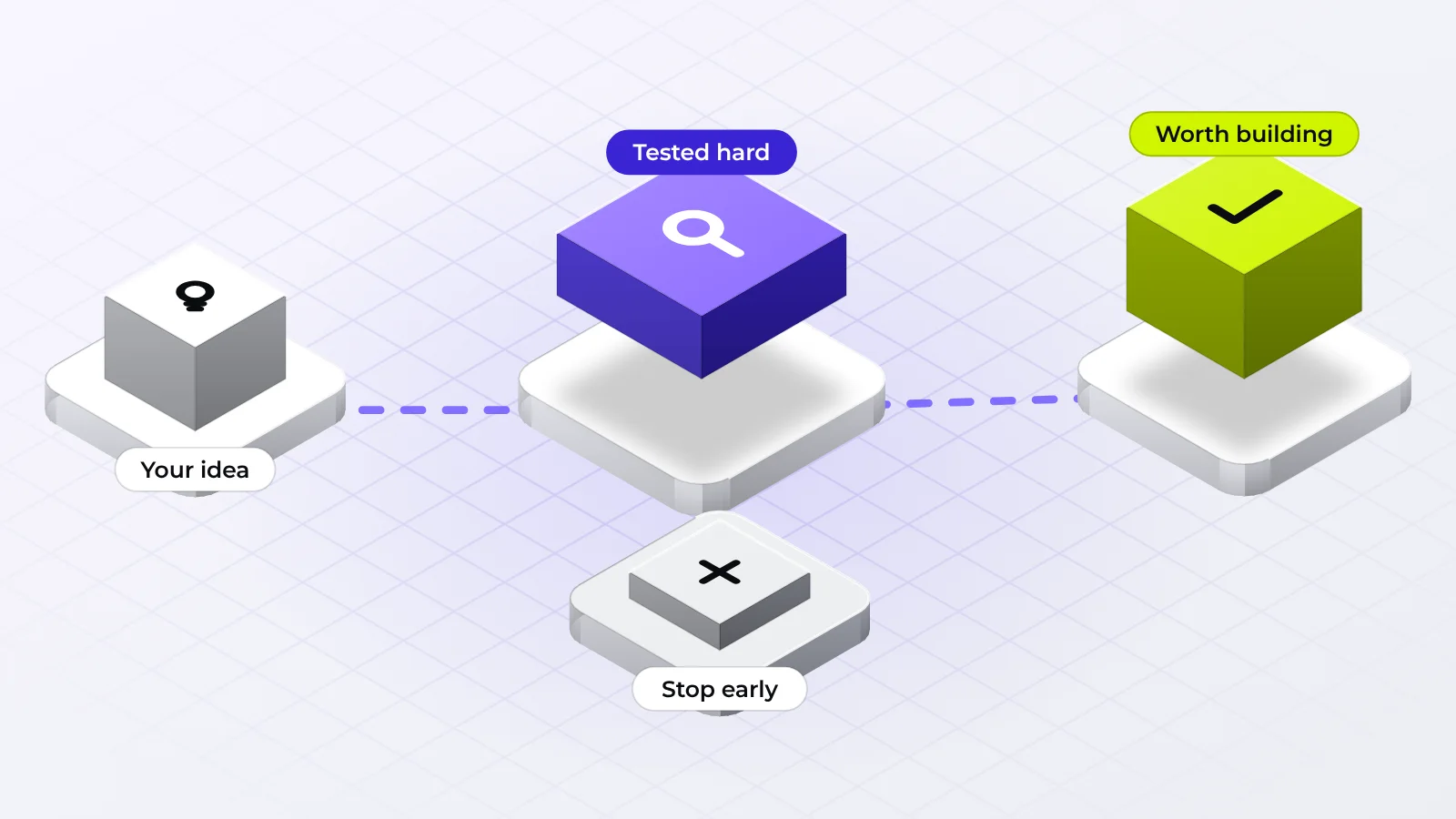
Many startup ideas and new offers should be stopped early, because the evidence says they won't work as described and stopping before you build is cheaper than finding out afterwards. Nobody counts ideas, but businesses do get counted. Only 38.4% of UK businesses born in 2019 were still trading five years later (ONS), and poor product-market fit was cited in 43% of the VC-backed shutdowns since 2023 where CB Insights could identify a reason.
The address of this page says 59 percent, so I owe you an explanation. That figure came from a small early sample of our own runs, shown on an earlier version of our verdicts and outcomes page. It was far too small to be a rate, so we withdrew it and you won't find it repeated below. We kept the address so old links still work. Our own verdict percentages will go on that page once the sample is big enough to mean something, and corrections go on the errata page. I'd rather tell you that plainly than leave a number in the URL and hope nobody asks.
What follows is what the outside evidence says, what a Stop verdict means and how it differs from changing course, the patterns that usually sit behind one, and how to write kill criteria before you've spent the money.
What the Outside Evidence Says
The Office for National Statistics tracks how many new UK businesses survive. In its Business demography, UK: 2024 bulletin, published in November 2025, the five-year survival rate for businesses born in 2019 was 38.4%. It ran from 43.5% in the South West to 30.6% in the West Midlands.
| South West (highest region) | 43.5% |
|---|---|
| UK overall | 38.4% |
| West Midlands (lowest region) | 30.6% |
Source: Office for National Statistics, Business demography, UK: 2024, Published 20 November 2025. Survival means still trading in 2024. Businesses close for many reasons, including sale, merger and retirement, so this isn't a pure failure rate. Chart by ThriveFinity.
Read that with care. A business can close because its owner retired or sold up, and the figure covers every kind of business, not only ones launched on a new idea. It still tells you that most of them weren't trading five years on.
Venture-backed companies give a clearer view of why. CB Insights analysed 431 VC-backed companies that shut down since 2023 and identified reasons for 385 of them. Running out of capital came top at 70%, though the report says that is almost always the final cause of death, not the root problem. The root problems were poor product-market fit (43%), bad timing (29%) and unsustainable unit economics (19%). Companies could cite more than one. I break the 43% down by stage in what the 43% really means.
| Ran out of capital | 70% |
|---|---|
| Poor product-market fit | 43% |
| Bad timing | 29% |
| Unsustainable unit economics | 19% |
Source: CB Insights, The top reasons startups fail, 2026. Companies could cite more than one reason, so the bars add up to more than 100%. Chart by ThriveFinity.
These were companies that had persuaded investors to fund them, and poor product-market fit still featured in 43% of the explained failures. I'd expect an unchecked idea to do no better, though that's my inference and not something either dataset measures. Harvard Business School's Tom Eisenmann makes a related point in the summary of his 2021 HBR article.
Like Triangulate, an online dating start-up, they keep rushing to launch fully functional offerings that don't fit any market needs.
What this means for a new offer in an established company
Nobody publishes a failure rate for new offers launched by established companies, so I won't invent one. The logic carries over anyway. A new service line, tier or segment has to clear the same tests as a start-up: real demand, a buyer you can name, and a price that covers delivery.
What differs is the cost of getting it wrong. An established company rarely goes under because of one bad offer. It loses a quarter of sales time, a marketing budget, the delivery team's attention, and the slot where a better offer could have gone. Marty Cagan calls the internal version business viability risk, which he defines as whether this solution also works for the various aspects of our business. A new offer can be wanted by buyers and still be wrong for the company selling it. A Stop on a new offer is often good news in disguise, because it's cheaper now than in two quarters' time.
What a Stop Verdict Actually Means
A Stop means there's a flaw in the idea, as described, that the evidence says can't be worked around. It's a judgement on the idea and says nothing about the founder or the team.
As described matters. A Stop applies to one combination of buyer, problem, offer, price and delivery model. Change one of those enough and you have a different idea, which might do much better. So a useful Stop comes with reasons attached: which lens failed, what evidence was missing, and what new evidence could change the answer.
If you get one, I'd do three things in this order.
- Read which lens failed.
- Ask whether new evidence could change it, and if so, go and get that evidence from buyers instead of arguing with the verdict.
- Look at what else turned up along the way, because a Stop on one offer often points at a better one next to it.
Our guide to what market validation involves sets out six steps for gathering that evidence.
What I'd avoid is rerunning the same idea through a friendlier tool until it says yes. A chat assistant will usually oblige, and we've written about why ChatGPT tends to call your idea brilliant.
The Five Answers
Offer Validation ends in one of five answers, and Stop is only one of them. Building something nobody buys is the more expensive outcome.
| Answer | What it means |
|---|---|
| Go | The evidence supports it. Proceed, with the next steps named in the report. |
| Go With Conditions | Proceed only once specific, measurable, time-bound conditions named in the report are met. |
| Change Course | The core insight holds, but the current path does not. A significant change of buyer, channel, price or model is needed. |
| Stop | There is a flaw the evidence says cannot be worked around. Stopping early is far cheaper than finding it after launch. |
| Wait | The idea is sound but the timing is not. The report names what to watch and when to look again. |
These are the same definitions we publish on the verdicts page. They're definitions only. We don't publish how often each answer is given, for the reason above.
Stop vs Change Course
Change Course means the core insight holds but the path doesn't. Stop means the problem itself, as defined, isn't painful, frequent or valuable enough to build a business on. Founders who get a Stop often ask whether it should have been a Change Course, so here's how I'd tell them apart.
| Points to Stop | Points to Change Course |
|---|---|
| Target buyers don't feel the problem often or badly enough to act | Buyer pain is confirmed, but the solution is wrong for that segment |
| What buyers will pay is below what it costs to deliver | The pricing model doesn't work, but a different model might |
| The problem is real but already solved well enough by what buyers do now | A real problem is aimed at the wrong buyer |
| The market is too small to support the business at any realistic price | The route to buyers is broken, but the offer itself is sound |
| Several lenses fail at once, with no shared fix | New evidence exists that could change the answer on a second look |
Real founders face this choice in messy form. A solo founder selling an AI chatbot to real-estate agencies described it in January 2026, with ten paying customers and conversion rates they weren't happy with:
I’m currently at a crossroads: double down and iterate hard (UX, trigger points, copy, entry timing), pivot the product or target audience, or accept this as weak signal and shut it down.
That's a Go With Conditions, Change Course or Stop decision made without a framework. Ten paying customers is real evidence of some demand. Whether it's a Stop depends on the kill criterion they set at the start, and if they didn't set one, that's the first thing to fix.
Four Patterns Behind Most Stops
A Stop usually comes from one lens failing outright, such as a buyer nobody can define, or from several failing together with no shared fix. In practice they tend to take one of four shapes. These are patterns I recognise from the evidence and not findings from a dataset of ours. The lens numbers refer to our 12-lens validation framework.
1. The painkiller nobody takes
The problem is real, and buyers agree it exists when you ask. But it isn't painful enough to make them act, and they've learned to live with it (lenses 1 and 3). There's no buying behaviour to point to, only stated intentions. Vicki Morwitz's review of research on consumers' purchase intentions finds they predict future sales, but imperfectly. That's consumer research, but the lesson travels: a room full of yes, I'd buy that proves less than it feels like.
2. The solution looking for a problem
The founder has a strong capability and has built something impressive. The technology is described in detail and the buyer's problem is vague, or worked out backwards from what the technology can do (lenses 1 and 3 again).
Paul Graham warned about this in his November 2012 essay on startup ideas. Founders who begin by trying to think of startup ideas, he wrote, produce bad ideas, and he says why that's dangerous.
It yields bad ideas that sound plausible enough to fool you into working on them.
At Y Combinator they call these made-up or sitcom ideas.
3. The economics that never close
The problem is real and the solution is good, but the numbers are broken. Each customer costs too much to win for the size of the market, or the price needed for a profit is more than the buyer will pay (lenses 5 and 11).
4. The crowded room without a key
The problem is well understood and the market is big, but well-funded incumbents already serve it. The idea doesn't name a wedge they can't easily copy, such as a specific segment, a route to buyers or a capability (lens 9). Regulation can also end an idea outright when the rules remove its core promise or make the compliant version uneconomic (lens 10).
AI coding tools make building quick and cheap, which I think makes pattern 2 easier to fall into. One owner of a profitable software consultancy described shipping 22 products in a year with AI coding tools, at one to three weeks each, none with real traction:
Building is fun. Selling is hard. I kept doing the fun thing.
Their own diagnosis, in the same post, was that they'd optimised for ships completed instead of problems validated or customers acquired. When a build takes a few weeks, the expensive part is no longer the code. It's the months spent selling something nobody asked for.
Why Stopping Is So Hard, and How to Make It Easier
Stopping is hard because the decision usually gets made late, by the people with the most invested. The fix is to make it early, in writing, before the investment builds up.
Annie Duke, the former professional poker player who now writes about decision-making, spells out what a good rule looks like in a 2022 article for Behavioral Scientist.
The best quitting criteria combine two things: a state and a date.
A state is an objective, measurable condition, and a date is when you'll check. Her template is If I haven't done X by Y (time), I'll quit.
The same article explains why we don't do this naturally. It describes a mental model from Astro Teller, who runs Alphabet's X lab, called monkeys and pedestals. If you're trying to train a monkey to juggle flaming torches on a pedestal, the monkey is the hard part and the pedestal is easy. Building pedestals feels like progress but isn't, and each one adds sunk costs that make it hard to quit. Polishing a pitch deck while the demand question sits unanswered is the same trap.
A practical way to find your own kill criterion is a premortem, which Gary Klein described in HBR in 2007. The team assumes the project has just failed and writes down why. That's Klein's method. The next step is my suggestion: take the most convincing reason on the list, turn it into something you can measure, and put a date on it.
The Case Against Stopping Too Early
Stopping too early is a real risk too. Early evidence is thin, and a weak signal isn't the same as a negative one. That's why there are five answers and not two.
Wait is the one people forget. It means the idea is sound but the timing isn't, and the report names what to watch and when to look again. A buyer's budget cycle, a rule about to change or a technology that isn't ready can turn a Stop today into a Go next year. Bad timing was cited in 29% of the VC-backed shutdowns CB Insights could explain, so it deserves to be taken seriously as its own answer.
Three things guard against a premature Stop. First, grade the evidence. A Stop resting on D and E grades (guesses and weak sources) should usually be a Wait, or a Go With Conditions with a test attached. Second, separate the problem from the solution. If the problem holds up and the offer doesn't, that's a Change Course. Third, look at what you learned on the way. Paul Graham makes this point about founders who want to change direction:
So when I talk to founders who want to change direction, the first thing I ask is: what new problems did you notice while trying to solve the old one?
A stopped idea often leaves behind the thing you should have built in the first place. If you're restarting from a problem, Michael Seibel's Startup School talk covers where to begin: the problem, why you're the person to solve it, a first version and your first users.
A Five-Point Check Before You Build
These five questions catch the most common Stop patterns. Answer each one with evidence before you submit an idea for validation or start building.
- Do you have evidence of buying behaviour, or only stated interest? Interviews where people say they'd pay aren't enough. Deposits, pre-orders, paid pilots and letters of intent are. If all you have is interview quotes, the demand lens will probably fail.
- Do your numbers work at the price buyers already pay for alternatives? Use what your target buyer actually paid a competitor or substitute in the last 12 months. A theoretical price doesn't count.
- Can you name one channel that reaches your first 100 buyers without paid ads? If the plan starts with we'll run ads, I'd treat that as a warning sign. Find the community, partner or event where your buyers already gather.
- Is there an incumbent that's serving the market badly? A market with no incumbents is often just an assumption that the problem exists. A market where incumbents are stagnant suggests the problem is real and current answers are weak.
- Can you describe your first buyer specifically? Not SMBs in the UK but operations managers at logistics firms with 20 to 80 staff who schedule the fleet in spreadsheets. If you can't name the company type, the role and their current tool, the idea is too abstract to test. The UK had an estimated 5.7 million private sector businesses at the start of 2025, and 75% of them had no employees besides their owners. SMBs isn't a buyer you can test.
If you're an established company, add a sixth: what happens to existing revenue if this works? A new tier that pulls customers down from a dearer one can look like growth and act like a price cut. Our guide to testing an offer or price change covers how to check.
Where ThriveFinity Fits
Our Offer Validation service gives you one of the five answers, with the evidence and reasons attached, before you commit the budget. It's desk research. It can tell you how strong the case for demand looks and where the biggest risk sits, but only real buyers can prove they'll pay.
- Offer Signal (free, under an hour): a directional Go, Go With Conditions, Change Course, Stop or Wait, with all 12 lenses scored and three costed next moves. It's automated and unsigned. Run a free Offer Signal.
- Build Verdict (£149, within 24 hours): a named verifier grades all 12 lenses A to E, tests the offer against simulated buyer personas, sets the stop criteria and signs the verdict. If any factual claim in your signed deliverable is not supported by its cited source, or is a factual error we should have caught, tell us within 30 days. We correct and re-sign it within 5 working days. If the correction changes the verdict, we redo it free, and if we cannot fix it, you do not pay for that deliverable.
We're not the right choice if you want reassurance. A Build Verdict looks for the reasons an idea fails, and a Stop is one of its five possible answers. We're also no substitute for talking to buyers. If you haven't had a single conversation with someone who has the problem, do that first. It's free, and it'll make any verdict, ours or anyone else's, far more useful.
❓ Common Questions
How do I know when to kill a startup idea?
How does a Stop verdict differ from an investor rejection?
Can a Stop verdict be challenged?
Sources
- Office for National Statistics. Business demography, UK: 2024. 20 November 2025.
- CB Insights Research. The top reasons startups fail (431 VC-backed shutdowns since 2023, reasons identified for 385). 5 March 2026.
- Tom Eisenmann. Why Start-ups Fail. Harvard Business Review, May to June 2021.
- Marty Cagan. The Four Big Risks. Silicon Valley Product Group, December 2017.
- Vicki G. Morwitz. Consumers' Purchase Intentions and Their Behavior. Foundations and Trends in Marketing, 2014.
- Paul Graham. How to Get Startup Ideas. November 2012.
- Annie Duke. Mental Models to Help You Cut Your Losses. Behavioral Scientist, 7 November 2022.
- Gary Klein. Performing a Project Premortem. Harvard Business Review, September 2007.
- Department for Business and Trade. Business population estimates for the UK and regions 2025. 2 October 2025.
- Y Combinator. How to Get and Test Startup Ideas - Michael Seibel. YouTube, 4 April 2019.
- ThriveFinity verdict definitions and Accuracy Commitment wording, as published on the verdicts page and in the refund policy (October 2026).