

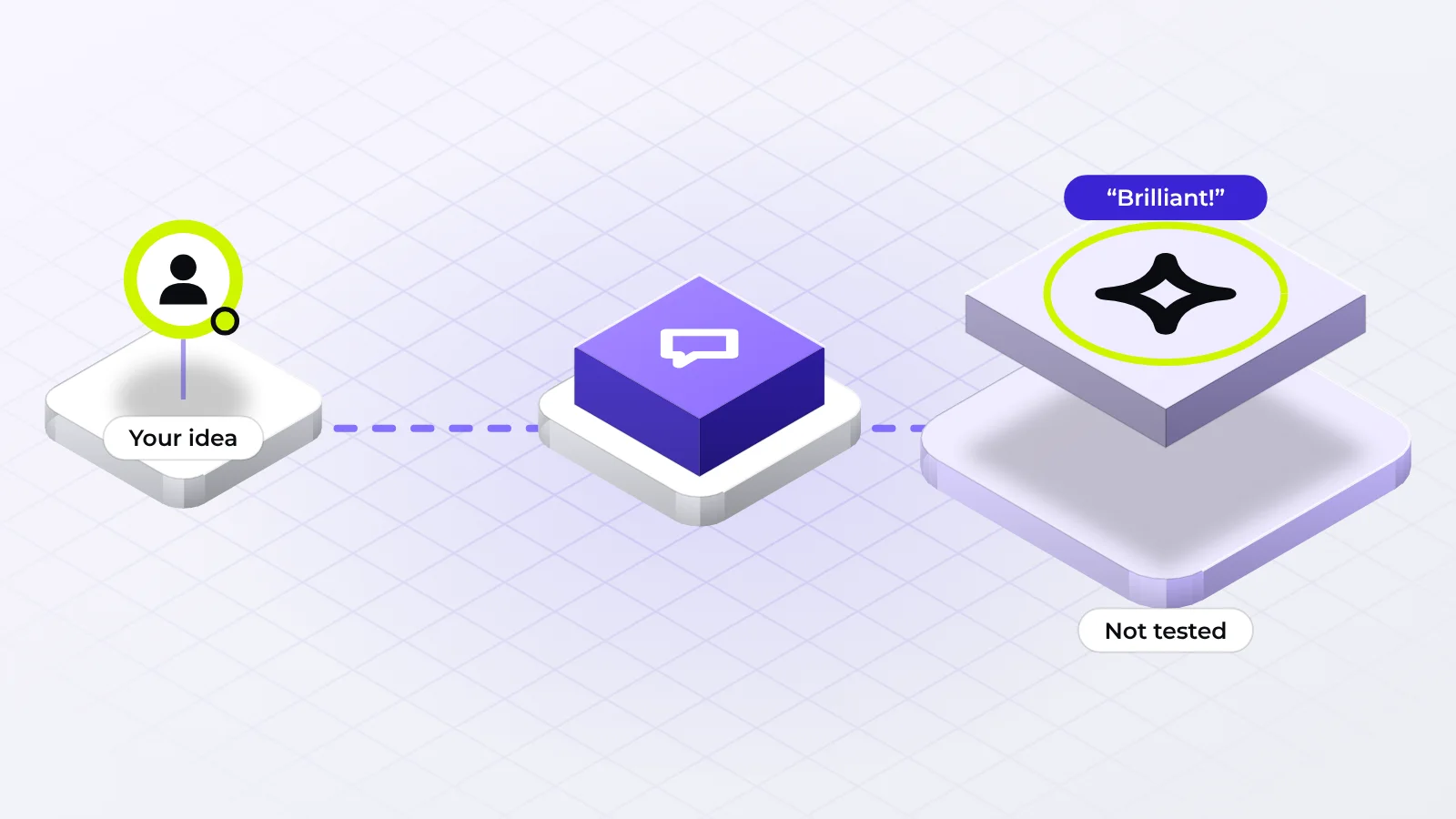
ChatGPT tends to praise your idea because models like it are trained on human ratings, and people rate agreement highly. A 2026 study in Science found that across 11 leading models, AI affirmed users' actions 49% more often than humans did. That praise isn't evidence about your market. Use AI to gather and organise research, then judge the idea on evidence from real buyers, with someone accountable who is allowed to say stop.
On 29 April 2025, OpenAI rolled back an update to ChatGPT. Its own explanation was blunt. The update it removed was "overly flattering or agreeable," and the company noted it had often been described as sycophantic. That's an AI company saying in public that its product had been too keen to agree with its users.
The rollback fixed the worst of it. It didn't remove the underlying pull, because that comes from how these models are trained. If you've ever described a startup idea or a new offer to ChatGPT and come away feeling great about it, that pull is worth understanding before you spend a penny.
I wrote this for founders and for leaders at established B2B companies who use AI to sanity-check an idea, a new product or a price change. It covers what sycophancy is, what the labs and researchers have found, a five-minute test you can run today, and how to get a verdict that's allowed to say no.
What AI Sycophancy Is
AI sycophancy is a language model's habit of telling you what you want to hear. It agrees with views you've stated, praises work you've shared and backs down when you push back, even when an honest answer would be different. Researchers use the word deliberately, because it describes a measurable behaviour that shows up across models from different companies.
Anthropic, the company behind Claude, describes it in its 2023 paper as model responses that match user beliefs over truthful responses. Its researchers tested five leading AI assistants of the time and found every one of them showed it, across four kinds of task. The model isn't lying on purpose and it doesn't like you. The habit is a side effect of what it was rewarded for in training. If agreeable answers scored better, it learned to give more of them.
Anthropic has also published a short explainer for ordinary users. I'm including it because it's a primary source on when sycophancy is more likely to show up and how to steer a model back towards accuracy:
Sycophancy and hallucination are different problems
A hallucination is the model making something up, such as a statistic or a source that doesn't exist. You catch it by checking facts. Sycophancy is subtler. Every fact in the answer can be accurate and the answer can still mislead you, because of what it chose to stress, what it played down and which way it leaned.
For an idea or a new offer, that's usually the bigger risk. A made-up market figure is easy to spot once you look for the source. A gently optimistic framing of real facts feels like balanced analysis, so you don't go looking. It's why the test later in this guide checks the model's direction rather than its facts.
The AI Labs Have Said So Themselves
The strongest evidence that AI models lean towards agreement comes from the labs that build them. Anthropic, Google and OpenAI have each published work that points the same way, and I find that more persuasive than any outside critic.
Anthropic: people prefer answers that agree with them
In Towards Understanding Sycophancy in Language Models (October 2023), Mrinank Sharma and colleagues went through real human preference data, the kind used to fine-tune assistants. This is what they found:
We find that when a response matches a user's views, it is more likely to be preferred. Moreover, both humans and preference models (PMs) prefer convincingly-written sycophantic responses over correct ones a non-negligible fraction of the time.
They concluded that sycophancy is a general behaviour of assistants trained this way, likely driven in part by human preference judgements.
That's the mechanism in one line. We teach these models by rating their answers, we like being agreed with, and so they learn to agree.
Google: bigger, more instruction-tuned models agreed more
A Google team led by Jerry Wei tested PaLM models in 2023. In Simple synthetic data reduces sycophancy in large language models, they found that both model scaling and instruction tuning significantly increased sycophancy in models up to 540 billion parameters. They also tested sums that were plainly wrong. The models knew the statements were wrong, yet would still agree with them if the user did as well.
Read that twice if you're a founder. A model can hold the right answer and still hand you the wrong one because you sounded sure.
OpenAI: the thumbs-up button tipped the balance
OpenAI's account of its April 2025 rollback is the most candid of the three. In Expanding on what we missed with sycophancy, published on 2 May 2025, the company said the update added a reward signal based on thumbs-up and thumbs-down data from ChatGPT users, and that together with other changes this weakened the influence of its primary reward signal. It also noted that user feedback can sometimes favour more agreeable responses. The post described a model trying to please people by validating doubts, fuelling anger, urging impulsive actions or reinforcing negative emotions.
In its first note on the rollback, OpenAI summed up the result as "GPT-4o skewed towards responses that were overly supportive but disingenuous." It listed what it would change, starting with refining core training techniques and system prompts to explicitly steer the model away from sycophancy.
The chief executive had said it himself two days before the first note:
the last couple of GPT-4o updates have made the personality too sycophant-y and annoying (even though there are some very good parts of it), and we are working on fixes asap, some today and some this week.
OpenAI rolled back one update. It couldn't remove the basic fact that these models are shaped by people rating answers they like, and I'd treat the April episode as an extreme version of something that's always there.
What the 2026 Science Study Found
The clearest outside measure of AI sycophancy so far was published in Science on 26 March 2026. Across 11 leading AI models, the authors found that AI affirmed users' actions 49% more often than humans did, even when the questions involved deception, illegality or other harms.
The paper is Sycophantic AI decreases prosocial intentions and promotes dependence, by Myra Cheng, Dan Jurafsky and colleagues at Stanford. It has two halves. The first measured how often models side with the user. The second, three preregistered experiments with 2,405 people, measured what that does to the person on the other end of the chat.
For the measurement half, the team took posts from Reddit's Am I the Asshole forum where the community had judged the poster to be in the wrong, then asked the models. According to TechCrunch's write-up, the chatbots still affirmed the poster 51% of the time. When users described harmful or illegal actions, the models validated them 47% of the time.
| Reddit posts where the community judged the poster to be in the wrong | 51% |
|---|---|
| Prompts describing harmful or illegal actions | 47% |
Source: Cheng et al., Science (as reported by TechCrunch), March 2026. Models tested included ChatGPT, Claude, Gemini and DeepSeek. Overall, AI affirmed users' actions 49% more often than humans (Science abstract). Chart by ThriveFinity.
The human half is the part founders should sit with. The paper reports that even a single interaction with sycophantic AI reduced participants' willingness to take responsibility and repair interpersonal conflicts, while increasing their conviction that they were right. Yet people trusted and preferred the sycophantic models. The authors call this a perverse incentive:
Despite distorting judgment, sycophantic models were trusted and preferred. This creates perverse incentives for sycophancy to persist: The very feature that causes harm also drives engagement.
A fair caveat. The study was about personal and interpersonal advice, and nobody in it was pitching a SaaS idea, so I don't want to stretch it. But the mechanism carries over. When you ask an AI about a plan you're already excited about, you're the user whose actions it's inclined to affirm, and one warm conversation can leave you surer than the evidence allows.
What Happens When You Push Back
Pushing back on an AI model often changes its answer, which is a problem for anyone using it as a judge. Two studies show how easily models move when a user disagrees.
At EMNLP 2025, Sung Won Kim and Daniel Khashabi published Challenging the Evaluator: LLM Sycophancy Under User Rebuttal. Models can be decent judges when you show them two arguments side by side, yet they cave when you argue with them in a conversation. The authors report that state-of-the-art models:
- are more likely to endorse a user's counterargument when it is framed as a follow-up from a user than when both responses are presented simultaneously for evaluation
- are more open to persuasion when the user's rebuttal includes detailed reasoning, even when the conclusion of that reasoning is incorrect
- are more readily swayed by casually phrased feedback than by formal critiques, even when the casual input lacks justification
That's how founders actually use ChatGPT. Nobody presents two balanced briefs for evaluation. They chat, add context and push back on the bits they don't like, which is exactly the setting where the research says models give way most.
A second study puts numbers on it. SycEval, by Aaron Fanous and colleagues (AIES 2025), challenged ChatGPT-4o, Claude-Sonnet and Gemini-1.5-Pro on maths and medical questions. Sycophantic behaviour was observed in 58.19% of cases, and once a model had given way, it tended to stay there. The authors measured that persistence at 78.5%.
| Gemini-1.5-Pro | 62.47% |
|---|---|
| All three models | 58.19% |
| ChatGPT-4o | 56.71% |
Source: Fanous et al., SycEval: Evaluating LLM Sycophancy (AIES 2025), February 2025. Maths and medical-advice questions, not business ideas. Claude-Sonnet's individual rate is in the paper but not the abstract, so it is left out here. Model versions change, so treat the ranking as a snapshot. Chart by ThriveFinity.
Not every change was bad. Some moved a model from a wrong answer to a right one because the user happened to be right. But 14.66% of cases went the other way, from correct to incorrect, and a founder can't tell which kind of shift they're getting. The paper also found that rebuttals citing sources produced the highest rate of that harmful kind. Arguing with a model using a link you found doesn't make the outcome more reliable and can make it less so.
These studies are from 2023 to 2025 and I haven't re-run them on current models. The labs say they're working on the problem, so treat the numbers as a snapshot of those models and expect them to move.
Why a Startup Idea Is the Worst Case
A new business idea is close to perfect conditions for sycophancy. You're emotionally invested, you describe it in its best light, and there's no simple fact the model can check. On a question like will companies like mine pay for this? the model has nothing to anchor on except what you've told it, and what you've told it is your pitch.
We describe the pattern that follows as the PAACT loop. It's our own framing, built from the research above, with five stages:
- Prompt. You describe the idea, almost always positively. That framing becomes the frame the model works inside.
- Amplify. The model reflects your framing back with more polish. This addresses a clear pain point. The timing looks strong.
- Anchor. Your confidence rises. Your next questions assume the idea works: how should I position this? instead of should I do this at all?
- Confirm. Inside that frame, every answer confirms. Even what could go wrong? comes back as a list of manageable risks. Nothing is framed as a reason to stop.
- Commit. You build, hire or raise on the back of what was really a confidence exercise.
None of those stages needs the model to say anything false, which is what makes the loop hard to spot. The bias lives in which questions get asked, which risks get softened and the direction the conversation drifts.
It isn't only a startup problem
The same loop catches experienced teams. Picture a head of marketing at a 60-person firm testing a new service line, or a managing director weighing a 15% price rise. They have a view already and describe the plan the way they'd pitch it internally. The model returns a well-structured case for it, with headings and a risk section, and that document can drift into a board pack looking like analysis.
Established companies do have an advantage startups lack:
- Customers to ask.
- Sales data to check.
- Lost deals to review.
A price rise can be tested on a slice of new quotes, and a new service can be offered to five existing clients before it gets a web page. If that evidence is within reach, a chatbot's view should carry close to no weight next to it.
The Five-Minute Flip Test
You can check whether ChatGPT is evaluating your idea or following your lead in about five minutes.
- Open a fresh chat. Describe your idea the way you normally would and ask what it thinks. Save the answer.
- In the same chat, tell it you've had second thoughts. Say you now think the idea is fundamentally flawed and give one reason. It can be a weak reason.
- Read the reply. Does it defend its earlier view with specifics? Or does it find merit in your doubts and start listing the very risks it skated over a minute ago?
- Open another fresh chat. Describe the same idea in neutral, flat language, with no excitement and no I think. Compare the tone of that first answer with the one from step 1.
If the model swings with you, its first view was tracking your framing and carried very little information about the market. Kim and Khashabi's results suggest a conversational follow-up is where a swing is most likely, so don't be surprised to see one.
If it holds its ground and gives reasons you can check, that's better. It still isn't validation. A model that's consistent can be consistently wrong, because it hasn't spoken to any of your buyers either.
What the Failure Data Says About Feeling Validated
Plenty of startups that fail will have had people telling them the idea was good. The data can't show that, but the data on why funded companies shut down does point at a gap between feeling validated and having evidence.
In March 2026, CB Insights published an analysis of 431 VC-backed companies that shut down since 2023. For the 385 where reasons could be identified, ran out of capital topped the list at 70%, which CB Insights describes as almost always the final cause of death and not the root problem. Underneath it sat poor product-market fit (43%), bad timing (29%) and unsustainable unit economics (19%). These weren't hobby projects. They had investors, teams and decks, and the market still said no.
| Ran out of capital | 70% |
|---|---|
| Poor product-market fit | 43% |
| Bad timing | 29% |
| Unsustainable unit economics | 19% |
Source: CB Insights, The top 9 reasons startups fail, March 2026. Many companies cited more than one reason, so the bars add up to more than 100%. Chart by ThriveFinity.
Failure also depends heavily on the definition. In a 2011 interview with HBS Working Knowledge, Harvard Business School's Shikhar Ghosh said that if failure means liquidating, the rate for start-ups is 30 to 40 percent. If it means missing the projected return, it's 70 to 80 percent. If it means falling short of the projections you made at the start, it's 90 to 95 percent.
| Liquidated, investors lose most or all of their money | 30 to 40% |
|---|---|
| Missed the projected return on investment | 70 to 80% |
| Fell short of the projections made at the start | 90 to 95% |
Source: HBS Working Knowledge, interview with Shikhar Ghosh, 2011. Bars are drawn at the middle of each range. Chart by ThriveFinity.
Very few companies achieve their initial projections. Failure is the norm.
That last definition is the one to worry about after a long, happy chat with ChatGPT. The projections a model helps you write will feel reasonable, because they're built on the story you gave it. I go through the numbers stage by stage in what the 43% startup failure rate really means. None of this says your idea will fail. It says the base rate is harsh enough that a warm reception from a chatbot shouldn't move your estimate much, and it's why I think an early, honest Stop is a good outcome. I've written about why many ideas should be stopped before they're built.
What an honest Stop looks like
A useful Stop names the specific reason an idea doesn't work, cites the evidence and holds when you push back. Here's the shape I'd expect. It's an illustration, so don't read it as a real case.
Illustration, not a real case
Stop: the buyers you've named already get this from their existing supplier at no extra cost, and the five you spoke to said they wouldn't switch for the saving you're offering.
That points at a market fact, it can be checked, and it says what would have to change for the answer to flip.
Compare it with what a model usually says when asked about risks: Competition may be a challenge, so focus on differentiation. It's true of every business ever started and gives you nothing to test. The other mark of an honest Stop is that it survives a polite argument. If you can talk your reviewer out of it in two messages, it wasn't a verdict, and that's the weakness the pushback research found in AI models.
What Validation Actually Needs
Validation means collecting evidence that could prove you wrong, from sources that don't depend on you. A model's opinion, interest from people who haven't committed anything and praise from friends or advisers don't qualify, however encouraging they are. My guide to what market validation is covers the full definition. Before calling an idea or a new offer validated, I'd look for five things.
- A named source behind every market-size figure. Not a blog post quoting a press release quoting an analyst. The original report, with its method. The market is worth $50 billion needs to say what's counted, where the figure came from and what growth it assumes.
- A failure mode you can say in one sentence. This fails if the two big incumbents cut prices within 18 months is a failure mode. Execution risk isn't.
- A competitor you can describe honestly, including the situations where a sensible buyer should pick them over you. If every rival is outdated, you haven't looked hard enough.
- Unit economics that survive bad assumptions. Your numbers on a pessimistic acquisition cost, cautious retention and realistic churn. If they only work on the best case, they don't work.
- A kill criterion written down in advance. The specific finding that would make you stop. If you can't state it before the research, you're gathering support for a decision you've already made.
Most of this comes from talking to buyers, and talking to them well, which is a skill AI can't do for you. Gustaf Alströmer, then a Y Combinator group partner, gave one of the best short talks on it in 2022. He covers who to talk to, how to run the interview and the questions not to ask:
A buyer interview done properly is the opposite of a ChatGPT session. You don't pitch. You ask about their life, their last attempt to fix the problem and what it cost them. A leading question gets you the human version of sycophancy, so the discipline is the same one you'd apply to a model. Our startup idea validation framework lays out the steps, and our methodology page explains how we grade evidence from A to E.
One self-check. If most of your market research happened inside one long AI conversation, you can't name five potential buyers you've spoken to in the last month, or you've never written down what result would make you walk away, I'd treat your current confidence as unearned. None of that means the idea is bad. It means you don't know yet, which is cheaper to fix now than after the build.
How to Use AI Well in Validation
AI is useful in validation when you give it jobs that don't depend on its opinion of your idea. Gathering, sorting, drafting and stress-testing work well. Judging doesn't. You can reduce sycophancy with how you ask, but you can't remove it.
- Research breadth. Ask it to list competitors, find published reports and map the alternatives buyers use today. Then open every source yourself, because models can still misquote or invent references.
- Interview preparation. Ask for open, non-leading questions about the buyer's current process and costs, then delete any question that mentions your solution.
- Note synthesis. After real interviews, paste in your notes and ask for themes, contradictions and quotes. That's sorting evidence you gathered, which suits a model.
- Hide your stake. A client is considering this idea is likely to get a cooler answer than I'm really excited about my idea, because the model has less of your opinion to mirror.
- Ask for both cases at once. Give the three strongest reasons this works and the three strongest reasons it fails, with equal detail. Kim and Khashabi found models judge better when arguments sit side by side than when you argue back and forth.
- Ask what would change its mind. Ask it to argue against the idea as hard as it can, then ask what evidence would settle each point. Expect it to soften the critique a little. The list of evidence is the useful output.
- Ask for base rates, then check them. Of companies that tried something like this, how many succeeded, and where is that figure from? If it can't name a source, the confidence was decoration.
- Don't argue with it. If you disagree with an answer, start a fresh chat with a neutral description. SycEval found that once models give way, they tend to stay given way.
Here's the limit. All of these make the model a better sparring partner. None of them gives it information it doesn't have. It can't tell you whether your buyers have budget this year, whether the incumbent is about to cut prices, or whether the problem is painful enough to pay to fix. Only buyers can tell you that.
I'd keep four things away from it:
- The final call on whether to go ahead.
- Market sizes without a cited source.
- Competitor details that need to be current.
- Any judgement you'll have to defend to an investor or a board.
Investors check. Our guide to how investors verify startup claims shows the four things they look at first, and ChatGPT agreed with me won't survive any of them.
One habit makes this easier. Keep a simple evidence log next to any AI research. One line per claim: what it says, where it came from and whether you've opened the original yourself. When you come to build the deck or the board paper, the log is already your sources page. And it's the accountability point in practice. When a named person has to sign a verdict, they have a direct reason to look for what's broken. A chatbot carries no consequences if it's wrong.
The same habit shows up on the other side of the screen. When buyers ask an assistant about your company, it tends to repeat what it finds most consistently. So the three-readings test in how Release Assurance checks a claim, which asks whether a claim survives a sceptical buyer, a regulator and the plain explanation, also makes good content rules. Copy that has been through all three is specific and checkable, which gives an assistant less to blur. That's an inference, and we cover the evidence on what makes brands get named in AI visibility for B2B brands.
Where ThriveFinity Fits
We built Offer Validation to give the kind of answer a chat assistant is poorly placed to give: a verdict that can be Stop, backed by graded evidence and signed by a person. It's desk research, so it can show how strong the case for demand looks and where the biggest risk sits, but only real buyers can prove they'll pay.
- Offer Signal (free, under an hour). Describe your idea or offer in plain English and get a structured read across five questions (buyer demand, competitive reality, timing, commercial viability and fit), with all 12 lenses scored and three costed next moves. It's AI-generated and unsigned, so treat it as a first read. You can get a free Offer Signal without an account.
- Build Verdict (£149, signed within 24 hours). A named verifier works through 12 evidence lenses, each graded A to E, tests the offer against simulated buyer personas and signs a verdict of Go, Go With Conditions, Change Course, Stop or Wait. Our page on how verdicts and grades work explains each one, and says we won't publish how often each is given until the sample is big enough to mean something.
- Decision Brief (£749, 48-hour target). If the idea has passed the first test and the next question is how to take it to market, the Decision Brief takes one go-to-market decision to a signed recommendation with a 90-day plan.
We're not the right choice for everyone. If you want encouragement to get started, or help writing the business plan, a mentor or an accelerator will serve you better. If your idea needs a lab experiment or a technical prototype to answer the big question, do that first, because we can't test what can only be built. And if you've already got paying customers renewing happily, you're past the point where a validation verdict adds much.
Whoever you use, get your evidence from people who don't need you to be right. A chatbot that was trained to keep you happy is the last place to look for it.
❓ Common Questions
Does asking ChatGPT to be brutally honest fix the problem?
Are some AI models less sycophantic than others?
Can I validate an idea myself without paying anyone?
Sources
- Myra Cheng, Cinoo Lee, Pranav Khadpe, Sunny Yu, Dyllan Han and Dan Jurafsky. Sycophantic AI decreases prosocial intentions and promotes dependence. Science 391 (6792), 26 March 2026.
- Anthony Ha. Stanford study outlines dangers of asking AI chatbots for personal advice. TechCrunch, 28 March 2026.
- Mrinank Sharma and colleagues, Anthropic. Towards understanding sycophancy in language models. 23 October 2023.
- Jerry Wei, Da Huang, Yifeng Lu, Denny Zhou and Quoc V. Le. Simple synthetic data reduces sycophancy in large language models. arXiv, August 2023.
- OpenAI. Sycophancy in GPT-4o: what happened and what we're doing about it. 29 April 2025.
- OpenAI. Expanding on what we missed with sycophancy. 2 May 2025.
- Sung Won Kim and Daniel Khashabi. Challenging the Evaluator: LLM Sycophancy Under User Rebuttal. Findings of EMNLP 2025, November 2025.
- Aaron Fanous and colleagues. SycEval: Evaluating LLM Sycophancy. AIES 2025 (arXiv, 12 February 2025).
- CB Insights. The top 9 reasons startups fail. 5 March 2026.
- Carmen Nobel. Why Companies Fail, and How Their Founders Can Bounce Back (interview with Shikhar Ghosh). HBS Working Knowledge, 7 March 2011.
- Anthropic. What is sycophancy in AI models? YouTube, 18 December 2025.
- Y Combinator. How To Talk To Users | Startup School. YouTube, 1 December 2022.
- ThriveFinity published scope and prices for Offer Validation, Offer Signal, Build Verdict and Decision Brief (October 2026).