

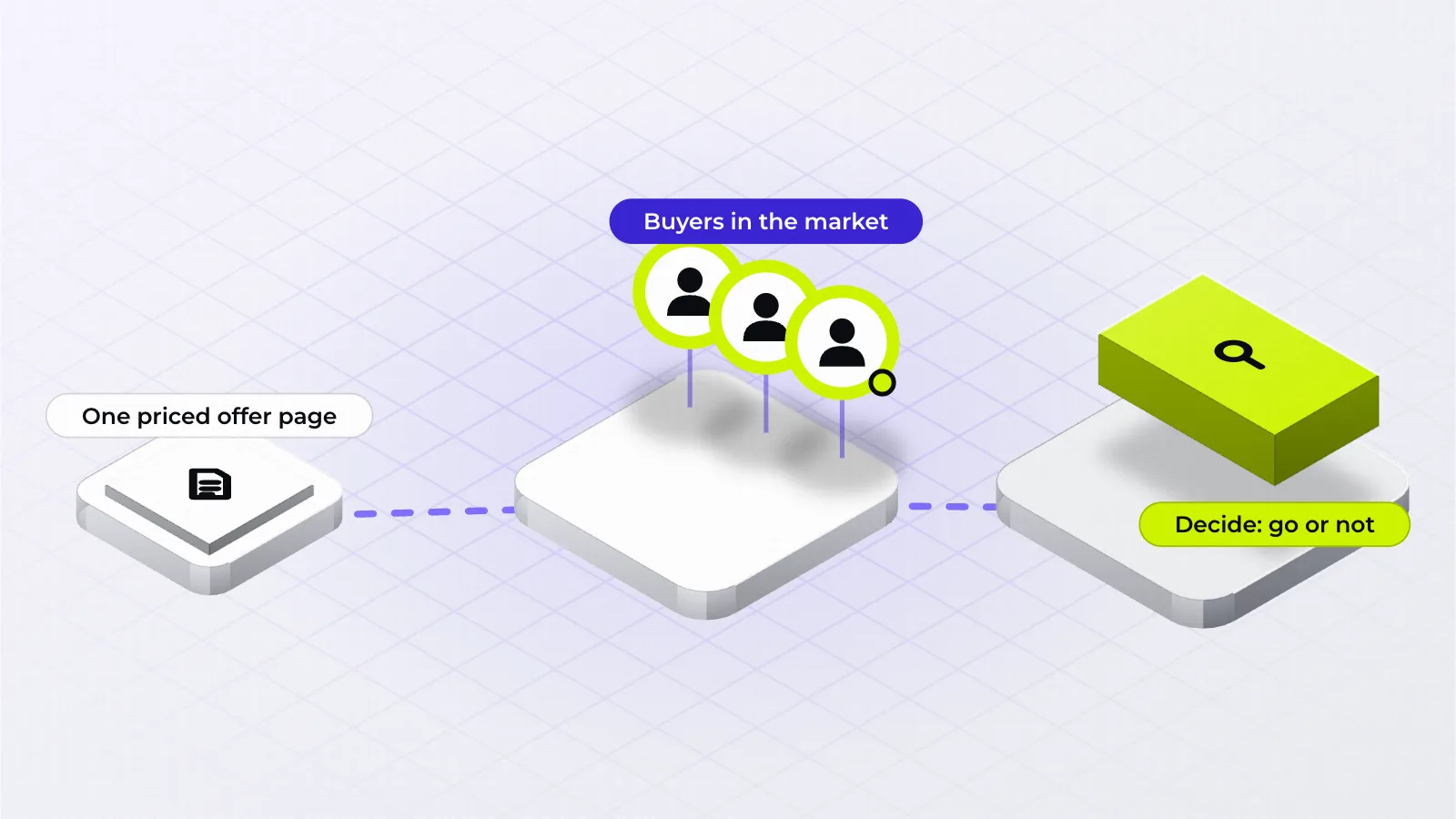
Test the offer with ten to fifteen real buyers in the target market before you localise anything. The cheapest honest test is a one-page offer priced in that market's currency, with its tax line, sent to a named list of buyers who match your segment, with a decision rule written down before the first reply arrives. If the replies and the priced asks clear the rule, localise. If they don't, you've saved the quarter.
This is written for founders and heads of growth at established B2B companies who already sell somewhere and want to sell the same thing in the US, the UAE, Singapore, the EU or the UK. It's about the offer, not the idea. If you're still deciding whether anyone wants the product at all, start with what market validation is. If you're testing a price change in a market you already sell in, the methods are in how to test an offer or price change, and this page doesn't repeat them.
We sell from India into the UK, the UAE and the US ourselves, and most of what follows is what we'd have liked someone to hand us first. Where a claim rests on a rule or a survey, the source sits next to it.
What Changes Between Markets, and What Doesn't
The offer usually travels better than people fear and the wrapper travels worse. The problem you solve is often the same in Austin, Dubai and Singapore. What changes is the currency the buyer thinks in, the tax line they expect to see, the proof they ask for before a call, how they prefer to pay and when they're at their desk. Those are the things a test has to get right, because a buyer who sees a GBP price with a UK VAT note on a page meant for them has already learnt you've not done the work.
| Dimension | UK | US | UAE | Singapore | EU |
|---|---|---|---|---|---|
| Currency to price in | GBP | USD | AED | SGD or USD | EUR |
| Tax line a business buyer expects | VAT 20% where it applies | Sales tax varies by state, often not charged on services sold remotely | VAT 5% | GST 9% | Reverse charge, buyer accounts for VAT at their rate |
| Selling a B2B service in from outside | Outside the scope of UK VAT when the customer belongs abroad | Varies by state and service | Varies, check the FTA rules | Varies, check IRAS | Usually no VAT charged by the seller |
| Proof buyers ask for first | Named clients, case studies, a UK-facing reference | Varies by sector, typically references and security questions | Varies, local references carry weight | Varies | Varies by country |
| Working-hours overlap from India | Afternoon and evening | Evening and night | Most of the day | Most of the day | Afternoon and evening |
Tax cells from HMRC VAT Notice 741A, the UAE Federal Tax Authority, IRAS and the EU's Your Europe guidance, all checked 30 October 2026 and linked in the Sources. Cells marked varies are ones we couldn't source for every case, so check them for your service. US state sales tax is not sourced on this page and is a question for your accountant. Hours are our own working pattern from Chennai.
Three of those tax cells are worth a sentence each, because they decide what goes on the offer page. HMRC's general rule is that a B2B service is supplied where the customer belongs, and services supplied in another country are outside the scope of UK VAT. The EU's guidance says that if you sell services to businesses in another EU country you don't usually charge them VAT, and they pay it at their own country's rate. Singapore's GST is 9% and the UAE's VAT is 5%. Whether either applies to your particular sale depends on the service and who the buyer is, which is why the table says varies more often than you'd like.
The B2B general rule for supplies of services is that the supply is made where the customer belongs.
For the non-tax rows, two public sources will save you a week. The US International Trade Administration publishes Country Commercial Guides, which it describes as reports on market conditions, opportunities, regulations and business customs prepared at US embassies. The UK's Department for Business and Trade publishes market guides that cover doing business, tax rates and import regulations by country. Read the guide for your target market before you write the offer, and note what it says buyers there expect in a supplier.
The Five-Step Test
The order matters. Each step produces something the next one needs, and the decision rule is set before you have any results to argue with.
- Define the offer for that market in one paragraph. Who it's for (segment, size, role), what they get, what it costs in their currency, how long it takes and what proof you can show. If you can't write the proof line without a client from that market, say what you can show instead: a comparable client elsewhere, a sample deliverable, a named person who signs the work. Write the decision rule now, in the form of step five, and date it.
- Price it in the local currency with the tax line. Start from what buyers there told you a wrong decision costs them and what the local alternatives charge, then set a number that ends the way prices end in that market. Put the tax wording under it: plus VAT at 5% in the UAE, plus GST at 9% in Singapore, reverse charge applies for EU business customers, and for the US a line that says tax is added where it applies. We show our own prices in GBP, USD, EUR, AED and INR by the visitor's region for this reason, and the wording under each one changed when we did it.
- Build a one-page offer, not a localised site. One page in the market's currency and spelling, with the paragraph from step one, the price from step two, the proof you actually have, a booking link that shows times in the buyer's zone and nothing else. The job of the page is to let a buyer say yes or no to a real offer. It is not the job of the page to look like a company that has been in that market for years.
- Talk to ten to fifteen real buyers, then make a priced ask. Build a list of named people who match the segment, in that market, and reach them through whichever channel they already use. The conversation has two halves. First, how they handle the problem now, what it costs them and who else they'd consider. Second, the offer page, the price and a direct question: would you buy this at that price this quarter, and if not, what would have to change? Record the answer in their words. Then make the ask for real. A pilot invoice or a signed order from even two of fifteen tells you more than fifteen polite maybes.
- Decide with the rule you wrote in step one. Use the same five answers we use on every signed verdict: Go, Go With Conditions, Change Course, Stop or Wait. The section below says what each one needs. Write down which it was, why, and what you'll do next, before you tell anyone the result.
One piece of first-hand advice on step four. From India, the UAE is the easy market to reach by phone because the working day overlaps almost completely. The US isn't. If your test needs twenty calls and the buyers are on the US west coast, plan for them to land late in your evening, and don't let a thin set of US conversations pass as a US result because they were hard to get.
What Counts as Evidence, in Order
Not every signal weighs the same, and the order below is the one we'd use to read a test. Each rung is worth more than everything below it put together.
- A paid pilot or order at the tested price, from a buyer in the segment, in the market.
- A signed letter of intent or a written yes with a start date, from the budget holder.
- A booked call taken by the person who'd sign, after seeing the price.
- A reply that engages with the offer, including a no with a reason you can act on.
- A click or a page visit. Useful for spotting a dead channel, useless for deciding.
There's a reason to care about the top rungs beyond the obvious one. 6sense's 2025 buyer survey, of just under 4,000 B2B buyers, reports that buyers evaluate an average of five vendors and choose one of the four on their day-one shortlist 95% of the time. It's a vendor survey and the fieldwork period isn't stated on the page, so hold it loosely. If it's anywhere near right, a buyer in a new market who hasn't heard of you is unlikely to be converted by a page. They're converted by a conversation that puts you on the list, and the test is how you find out whether that conversation works.
The Decision Rule
Set the thresholds before the test, from your own numbers: what the market has to be worth to justify the localisation spend, and how many buyers you'll talk to. Then read the result against the five answers.
| Answer | What the test showed | What to do |
|---|---|---|
| Go | At least one paid pilot or order at the tested price, and most priced asks came back yes or a reasoned not-yet | Localise pricing, site and outbound for that segment. Keep the one-page offer live while you build. |
| Go With Conditions | Strong replies and booked calls, no money yet, and the buyers named the same one or two conditions | Meet the conditions first (a local reference, a payment method, a contract term), then re-run the priced ask with the same people. |
| Change Course | Buyers want the outcome but not this offer: a different scope, a different buyer, or a price far from yours | Rewrite the one-paragraph offer for what they described and test again. Don't localise the old one. |
| Stop | Buyers in the segment handle the problem acceptably already, or the price they'd pay doesn't cover delivery from where you are | Stop for this segment and market. Write down what would reopen it. |
| Wait | Too few matching buyers reached, or the answers split with no pattern | Name the one thing that would settle it, set a date, and run that. Don't spend on localisation. |
The five answers are the verdict scale used on every ThriveFinity signed deliverable. The evidence thresholds are our recommendation, not a standard.
Common Mistakes
Translating the UK site. A full localisation before a test turns a cheap question into an expensive one and changes nothing about whether buyers will pay. The one-page offer answers the question for a fraction of the cost.
Pricing by exchange rate. A converted price produces an odd number that moves with the rate and signals that you haven't priced for the market. Set the local number from local evidence and keep it stable for the test.
Testing with friendly contacts. People who know you say yes to be kind and then don't buy. Count only buyers who match the segment and had no reason to be polite.
Reading one market into another. A Go in the UAE says nothing about Singapore. The tax line, the proof asked for and the buying pace all differ, and the table above is the short version of why. Run the test per market, even when the offer is identical.
Leaving the tax wording until the invoice. A buyer who sees the wrong tax line on the page wonders what else you've not checked. Put the right one on from the start, and ask an accountant in the market if the table says varies for your case.
Where ThriveFinity Fits
If you want the test designed and the result judged by someone who isn't invested in the answer, that's what the Decision Brief does. You pick one focus area at intake, which for a market entry is usually offer, pricing and conversion. You get a signed answer on the five-verdict scale, a seven-block Decision Card with its supporting documents and a 90-day action plan for that focus area, on a 48-hour target from the point your intake is accepted. It costs £749 plus applicable taxes, shown in your currency on the page, and the fee is credited in full to a Go-to-Market Build booked within 30 days, which is the service that then builds the localised positioning, site, deck and outbound once the answer is Go.
What the Brief doesn't do is talk to your buyers for you. The ten to fifteen conversations in step four are yours to have, and no report replaces them. If you'd rather check the offer yourself first, the free Offer Self-Check is a quick way to see where the gaps are before you spend anything.
Limits of This Page
- The tax cells are general rules checked on 30 October 2026 from the authorities linked. Whether a rule applies to your service and your buyer is a question for an accountant in that market. US state sales tax isn't sourced here.
- The ten-to-fifteen-buyer figure and the evidence ladder are our practice, not a published standard. A regulated or enterprise segment may need more conversations and a longer test.
- The 6sense figures come from a vendor survey with no stated fieldwork period. They're used to illustrate why conversations matter, not as proof of a rate.
- Our first-hand experience is selling services from India into the UK, the UAE and the US. We haven't sold into Singapore or the EU ourselves, so those columns rest on the public sources only.
- Errors we find are logged on the errata page.
Spotted something out of date or wrong on this page? Email om@thrivefinity.uk and we respond within 5 working days.
❓ Common Questions
How many buyers do I need to talk to before I decide?
Should I price in the local currency or just convert my UK price?
Can I run the test from the UK without a local entity?
What if the test says Wait?
Sources
- HM Revenue and Customs. Place of supply of services (VAT Notice 741A). Published 24 February 2010, updated 29 September 2022. Fetched 30 October 2026.
- European Union, Your Europe. Cross-border VAT. Fetched 30 October 2026.
- Inland Revenue Authority of Singapore. Current GST rates. Fetched 30 October 2026.
- UAE Federal Tax Authority. VAT. The page's VAT calculator shows the 5% rate. Fetched 30 October 2026.
- US International Trade Administration. Country Commercial Guides. Fetched 30 October 2026.
- UK Department for Business and Trade. Market Guides. Fetched 30 October 2026.
- 6sense. 2025 B2B Buyer Experience Report. Vendor survey, just under 4,000 respondents, fieldwork period not stated. Fetched 30 October 2026.
- ThriveFinity. Decision Brief page and canonical product record, checked 30 October 2026.