

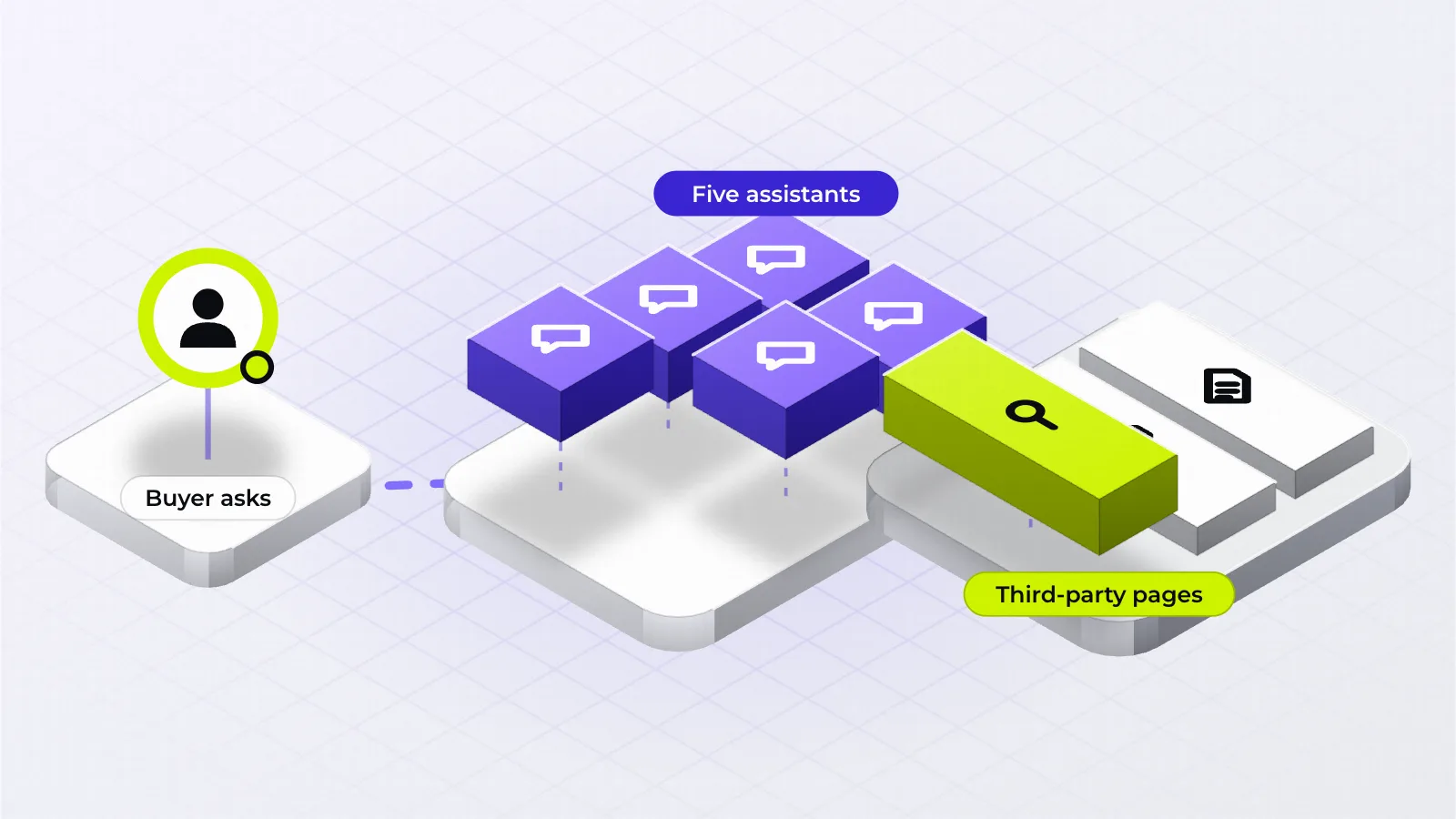
Each AI assistant reaches for a different kind of page when it answers a buyer. In our run of 26 October 2026, ChatGPT leaned on platform documentation and regulators, Claude on a long tail of agency and vendor sites, Perplexity on directories and the trade press, and Google AI Overviews on LinkedIn, YouTube and Reddit. Gemini returned links we couldn't resolve at all. If you audit only one assistant, you'll see one slice of where buyers' answers come from.
This page is for founders and marketing leads at B2B companies who want to know where to look before they change anything. It rests on one week's run of our own panel, 219 answers in total, so treat every count as an observation and not a rule. If the terms are new, start with what generative engine optimisation is.
How We Checked
We asked 46 locked questions on five assistants: ChatGPT, Claude, Gemini and Perplexity through their APIs with web search on, and Google AI Overviews through a search-results data provider, with the UK as the default location. The questions cover five groups: our own brand, generic UK questions about go-to-market and claim-checking help, and four buyer segments we track: payments and crypto companies, B2B software companies, Indian firms entering the US or UK, and law and professional-services firms. Each question was asked once per assistant.
That gave 230 requests and 219 answers. Eleven failed with a provider error (8 on Gemini, 3 on AI Overviews) and are left out, the same rule we use in every run. Of the 219 answers, 201 carried at least one source link. Together they held 1,970 links to 1,025 different websites. We count an answer once per site it cites, however many times that site appears in it. The raw counts are in the methodology trail and the run file named in the sources below.
What the 219 Answers Cited
Grouping the 1,025 sites by type, the most common source in an answer was an agency, vendor or consultant site: 156 of the 219 answers cited at least one. Platform documentation from Google, OpenAI, Perplexity or Bing came next, in 48 answers. LinkedIn was cited in 29, business directories and review sites in 27, regulators and professional bodies in 23.
| Agency, vendor and consultant sites | 156 answers |
|---|---|
| Platform docs (Google, OpenAI, Perplexity, Bing) | 48 answers |
| 29 answers | |
| Directories and review sites (Clutch, G2, F6S, Manifest) | 27 answers |
| Press and trade media | 24 answers |
| Regulators, government, bar and law societies | 23 answers |
| Other social (Facebook, Instagram, X, Medium) | 10 answers |
| YouTube | 8 answers |
| 7 answers |
Source: ThriveFinity AI Visibility panel v3, weekly run of 26 October 2026, 46 prompts on five assistants, each asked once, 2026. An answer can cite several types. The 24 Gemini answers whose links were Google redirect addresses are counted under platform docs because the domain is Google's, which overstates that type slightly. Our own site appeared in 25 answers, 20 of them to questions that named ThriveFinity. Chart by ThriveFinity.
Two things are worth holding onto. The pages behind buyer answers are mostly third-party pages: agencies writing about the category, the engines' own help pages, a professional network, a directory. And the mix is not fixed. It moved with the assistant and with the question, which is the rest of this page.
Engine by Engine
The table below is the first thing to read if you're planning an audit. The number of links per answer tells you how much each assistant will show you. The source types tell you where it looked.
| Assistant | Answers | With a link | Links | Sites | Most common source types (answers citing) |
|---|---|---|---|---|---|
| ChatGPT | 46 of 46 | 46 | 187 | 102 | Agency and vendor 33 · platform docs 20 · regulators 13 |
| Claude | 46 of 46 | 45 | 301 | 237 | Agency and vendor 40 · regulators 4 · press 3 |
| Gemini | 38 of 46 | 24 | 182 | 1 (redirects) | All links were Google redirect addresses |
| Perplexity | 46 of 46 | 46 | 972 | 607 | Agency and vendor 46 · directories 21 · press 18 · LinkedIn 12 |
| Google AI Overviews | 43 of 46 | 40 | 328 | 223 | Agency and vendor 37 · LinkedIn 17 · other social 10 · YouTube 8 · Reddit 6 |
Source: ThriveFinity AI Visibility panel v3, weekly run of 26 October 2026. Counts recomputed from the run file on 30 October 2026. Sites are distinct domains across the assistant's answers.
ChatGPT reached for documentation and rules
ChatGPT returned about four links per answer and drew on the narrowest set of sites, 102 in all. Its most cited pages were Google Search Central (12 answers), OpenAI's help centre (10) and OpenAI's developer documentation (8). For questions that touched compliance, it cited the FTC in four answers. When a buyer asks ChatGPT how to do something, it tends to answer from the people who wrote the rules.
Claude spread its citations widest
Claude cited 237 sites across 45 answers and no single site reached more than 4 answers, except ours on the brand questions. Forty of its 46 answers cited at least one agency or vendor page. If your category's smaller consultancies and tool vendors have written about a question, Claude is the assistant most likely to have read them.
Gemini's links couldn't be traced
All 182 links Gemini returned were addresses on Google's own redirect host, so we can't tell which sites they point to. Gemini's API passes grounded sources through its own links, and the grounding documentation describes citations as annotations tied to text segments rather than plain page links. The answers were grounded. For an audit, though, you have to read what Gemini says, not where it says it got it. Gemini also returned 8 of the 11 errors in the run.
Perplexity cited the most, and the most directories
Perplexity returned 972 links, about 21 per answer, from 607 sites. It was the only assistant where directories and review sites were common: Clutch in 7 answers, F6S in 5, The Manifest in 4, and LinkedIn in 12. The trade press appeared in 18 of its answers. Perplexity's documentation says its crawler exists to surface and link websites in its results and recommends allowing it in robots.txt, so a site that blocks PerplexityBot is unlikely to be one of those 607.
Google AI Overviews leaned on social and video
AI Overviews cited LinkedIn in 16 of 43 answers, YouTube in 8, Reddit in 6, Facebook and Medium in 4 each and Instagram in 3. No other assistant came close on social sources. Google's documentation says a page needs to be indexed and eligible for a snippet to appear as a supporting link, with no extra technical requirement, and that AI features are meant to send readers to a wider set of links than classic results.
To be eligible to be shown as a supporting link in AI Overviews or AI Mode, a page must be indexed and eligible to be shown in Google Search with a snippet, fulfilling the Search technical requirements. There are no additional technical requirements.
How the Question Changes the Sources
The buyer segment moved the mix as much as the assistant did. For payments and crypto questions, one specialist crypto marketing agency was cited in 9 of 44 answers, and the FCA and Dubai's VARA rulebook in 3 each. For law-firm questions, the Solicitors Regulation Authority appeared in 4 of 42 answers and the American Bar Association in 3, alongside OpenAI's own pages in 8. For questions about an Indian company entering the US or UK, LinkedIn was the single most cited site (10 of 41 answers) and the US International Trade Administration appeared in 4. Software questions pulled platform documentation into 13 of 45 answers.
Read that as a pattern, not a table of fixed facts: regulators show up where a buyer's question has a compliance edge, platform documentation shows up where the question is technical, and professional networks show up where the question is about trust in a person or a firm. The names will differ in your category. The types probably won't.
US, UAE and Singapore
We also ran a subset of the questions through Google AI Overviews with the searcher's location set to the United States (6 questions), the UAE (4) and Singapore (1). Ten answers came back. The pattern was consistent across all three: nine of the ten answers cited at least one agency site, and in the UAE and Singapore those were agencies based in that country, with names ending in .ae or .sg and Semrush's agency directory for Singapore. LinkedIn appeared in the US and Singapore answers. ThriveFinity was named in none of the ten.
Ten answers is far too few to conclude anything about a market. What it does show is that the sources follow the location setting, so an audit run from the UK tells you little about what a buyer in Dubai is shown. If you sell into several markets, as we do across the UK, US, UAE, EU and Singapore, run the check in each one.
What It Suggests
What we observed. One week, one panel, 219 answers. Each assistant favoured a different type of page, the question's subject pulled in different third parties, and the searcher's location changed which agencies were cited. Our own site was cited in 25 answers, 20 of them to questions that already named us.
What it suggests. AI visibility work that stops at your own website is working on the smallest part of the picture. The pages behind most buyer answers belong to other people: the engines' documentation, directories, professional networks, trade press, regulators and the agencies writing about your category. Being described accurately on those pages is at least as important as what your own site says. We hold this as a working hypothesis supported by one run, and we'll re-check it every Monday.
What to do next. Audit each assistant separately, in each market you sell into, and keep a list of the third-party pages that come back. That list is your off-site work plan. The checks below are in the order we'd run them.
What to Check on Your Site and Off It
- Confirm the crawlers can reach you. OpenAI's developer documentation says sites opted out of OAI-SearchBot will not be shown in ChatGPT search answers. Perplexity recommends allowing PerplexityBot. Google needs the page indexed with a snippet. Check robots.txt and your CDN rules first, because this costs nothing.
- Run your own buyer questions on all five assistants. Ten to fifteen questions in your buyer's words, once each, with web search on. Record who is named and which pages are cited. Treat Gemini as a text-only read.
- Sort the cited pages by type. Use the same groups as the chart above. The type that leads tells you where to work: documentation and regulators mean your technical and compliance pages need to be plain and quotable, directories mean your listings need to be complete and consistent, social means your LinkedIn page and any video need to say what your site says.
- Check how those pages describe you. Open every third-party page that named a competitor and look for your own company. If you're absent or described wrongly, that's the fix list. Our AI Presence service does exactly this across the profiles that get cited most.
- Repeat with the same questions. One run is a single draw. Judge change with ranges, as set out in why an AI visibility score needs a confidence interval, and never from one before-and-after answer.
Sites that are opted out of OAI-SearchBot will not be shown in ChatGPT search answers
If you'd rather have this measured for you every week, with the counts and ranges written up by a named person, that is what the AI Visibility service does. The free AI Presence Signal below is the smaller first reading.
Limits of This Page
- One run, 46 questions, each asked once per assistant, on one day. Four of the five tools were API calls with web search on, not the consumer apps, so a buyer's own session may differ.
- A citation shows where an assistant looked. It doesn't show why it chose a page or how much weight it gave it.
- Site types were assigned by us from the domain. Some agency sites could be called press and some vendor blogs could be called documentation. The broad shape holds under any reasonable grouping.
- Gemini's redirect links were counted as platform documentation because the host is Google's. Without them, platform docs were cited in 24 answers rather than 48.
- The US, UAE and Singapore runs are 10 answers in total. They show that location changes the sources, not what any market's sources are.
- Documentation from Google, OpenAI and Perplexity was checked on 30 October 2026 and can change. Errors we find are logged on the errata page.
Spotted something out of date or wrong on this page? Email om@thrivefinity.uk and we respond within 5 working days.
❓ Common Questions
Why did Gemini show no usable sources in this run?
Does Perplexity use more sources than the other assistants?
Will the same sources show up for my market and my industry?
Sources
- ThriveFinity. AI Visibility panel v3, weekly run of 26 October 2026 (46 prompts, five assistants, 230 requests) and the AI Overviews location runs for the US, UAE and Singapore. Counts recomputed from the run files on 30 October 2026. Method on the methodology page.
- Google Search Central. AI features and your website. Fetched 30 October 2026.
- Google AI for Developers. Grounding with Google Search. Page dated 28 October 2026. Fetched 30 October 2026.
- OpenAI. Overview of OpenAI crawlers. Developer documentation. Fetched 30 October 2026.
- Perplexity. Perplexity crawlers. Documentation. Fetched 30 October 2026.