

Competitive intelligence for a B2B company is a small habit, not a research project. Pick the decision it should inform, watch the same public sources every month, grade what you find, and write down the case against your own conclusion. One named owner, a diary slot and a shared log are enough. You don't need a research team.
"Is it just me, or is the 'monthly CI update' the most soul-crushing part of PMM?" That's how a product marketer opened a Reddit thread in February 2026. Hours of checking competitor blogs and pricing pages, a tidy PDF, and by the time sales opened it three weeks later the competitor had already moved.
If you run a company of 10 to 250 people without a product marketing team, you probably do the same thing in bursts. Before a pricing review, after a big loss, or when the board asks who else is out there. This guide is the version I'd want a leadership team of that size to run. It covers what to track, which UK sources hold up, where the legal lines sit, how to grade what you find, and a rhythm that survives a busy quarter.
What Is Competitive Intelligence, and How Is It Different From Competitor Analysis?
Competitive intelligence (CI) is the legal, ethical collection and analysis of information about your market, your buyers, your competitors and the trends affecting all of them, used to make specific decisions. Pricing, positioning, which segment to chase, whether to bid. The decision is what turns a pile of information into intelligence.
The terms get used loosely, so here's how I'd separate them:
- Competitor analysis looks at named rivals: what they sell, at what price, to whom, and how they describe themselves.
- Market research looks at buyers and demand: who needs what, how many of them there are, and what they'll pay.
- Competitive intelligence combines both, adds trends, and runs on a rhythm. Every finding is tied to a decision and has a date on it.
A competitor analysis can be finished. Competitive intelligence never quite is, because the market keeps moving. That's why most of this guide is about habits rather than reports.
Why Does One-Off Competitor Research Go Stale?
A one-off review is a snapshot, and snapshots start decaying the day they're taken. A rival changes its pricing page, hires a sales team in your region or wins a framework you bid for, and nobody notices until a prospect mentions it.
The trouble is usually structure rather than effort. A one-off session asks can we find something plausible? when it should ask what a sceptical buyer, or a sharper competitor, would find first. Here's the post behind that opening quote. The poster's own fix was to watch for specific signals, like pricing changes and new reviews, instead of doing bulk research. That's most of what a good routine does.
We spend hours monitoring/scanning competitor blogs and pricing pages, put them into a beautiful PDF (on Sharepoint, OneDrive, Google Drive) or Notion page, and by the time Sales actually looks at it 3 weeks later, the competitor has already shipped a new feature or changed their positioning.
There's survey evidence that competition is tightening, though it comes from a vendor and covers software companies. Crayon's 2025 State of Competitive Intelligence report surveyed more than 400 CI professionals at B2B SaaS companies between December 2024 and February 2025. It found sellers "facing competitors in nearly 7 out of every 10 deals", and companies rating their own effectiveness at competitive selling at just 3.8 out of 10. Crayon sells CI software and the sample is software companies, so treat the numbers as directional and expect other sectors to differ.
Is Competitive Intelligence Legal in the UK?
Yes, when it relies on public or legitimately obtained information. The limits come from four places: trade secrets law, computer misuse law, data protection law and contracts. This is general information, not legal advice. Take advice for specific situations.
Trade secrets
Regulation 3 of the Trade Secrets (Enforcement, etc.) Regulations 2018 sets the rule:
The acquisition, use or disclosure of a trade secret is unlawful where the acquisition, use or disclosure constitutes a breach of confidence in confidential information.
Regulation 2 defines a trade secret as information that's secret, has commercial value because it's secret, and has been subject to reasonable steps to keep it secret.
Most of what CI uses isn't secret at all. The EU directive behind those regulations, Directive 2016/943, lists lawful ways to acquire information, including "independent discovery or creation" and "observation, study, disassembly or testing of a product or object that has been made available to the public". On any sensible reading, reading a competitor's website or buying their product is fair game. Asking a new hire to bring a former employer's client list is not.
Computer misuse
Under section 1 of the Computer Misuse Act 1990, a person is guilty of an offence if they cause a computer to perform any function "with intent to secure access to any program or data held in any computer" and that access is unauthorised. In CI terms that rules out logging in with credentials you weren't given, guessing your way into a client portal, or using a login a customer shared with you.
Personal data
Information about a company isn't usually personal data. Information about named people often is. The ICO's guidance quotes the UK GDPR definition: "any information relating to an identified or identifiable natural person". So a spreadsheet of a rival's prices is fine, while a file profiling their sales staff by name brings data protection duties with it. Keep CI about organisations wherever you can. The ICO says this guidance is under review because of the Data (Use and Access) Act, so check the page before you rely on it.
Contracts and ethics
NDAs, employment terms and website terms of use can all restrict what you collect and how, for example automated scraping. Read the terms before you automate anything.
Ethics goes further than the law. I haven't found a professional code I can point you to, so this is my own line: don't misrepresent who you are to get information, don't pose as a prospect to extract a competitor's pricing, and record where every piece of evidence came from so anyone can check it later.
A quick test before you collect anything
When you're unsure about a source, ask three questions. Did this come from a public page, a product I bought, or someone free to share it? Would I be comfortable if the competitor saw exactly how I got it? Does it identify a person? If the first answer is no, the second is no, or the third is yes, stop before it goes in the file.
What Are the Steps in a Competitive Intelligence Framework?
A workable framework has five steps, and the first one does most of the work. Without a decision at the start, intelligence turns into a news feed.
- Define the decision. Pricing, a market entry, a repositioning, a bid. Write the question down in one sentence.
- Choose what to track. Named competitors and the real alternatives: doing nothing, in-house teams, generalists and, increasingly, AI tools. A market positioning map helps you see the full set.
- Collect from fixed sources. The same public and owned sources each time, captured with dates (see the UK sources below).
- Analyse and grade. Grade each finding by evidence strength and separate fact from inference.
- Report and set a review date. A recommendation, the strongest case against it, and when to check again.
Here's the sequence on a small example. The firm is fictional, a facilities management company with 60 staff, and it's here only to show the method.
- Decision. Should we bid for a council's cleaning framework when it's re-tendered next spring?
- What to track. The incumbent, two firms that won similar frameworks nearby, and the option buyers forget: the council bringing the work back in-house.
- Sources. Three years of award notices on Contracts Finder and Find a Tender, the incumbent's Companies House filings and officer changes, its current job adverts, and the notes from the firm's own two lost bids.
- Grading. Award values are high confidence, because they're published notices. The incumbent's spare capacity is medium, because it's inferred from hiring. A rumour from a subcontractor is low, and it's labelled that way.
- Report. Bid, but only for the two lots where award notices show smaller suppliers winning. The case against: the incumbent has just hired a bid manager. Review again when the tender notice goes live.
That's five sources and one page for one decision. If you only remember one step, make it the first. A team that starts with let's look at the competition usually ends with a slide nobody acts on. A team that starts with should we raise prices on the mid tier? ends with an answer.
Why Does CI Need Four Angles Rather Than One?
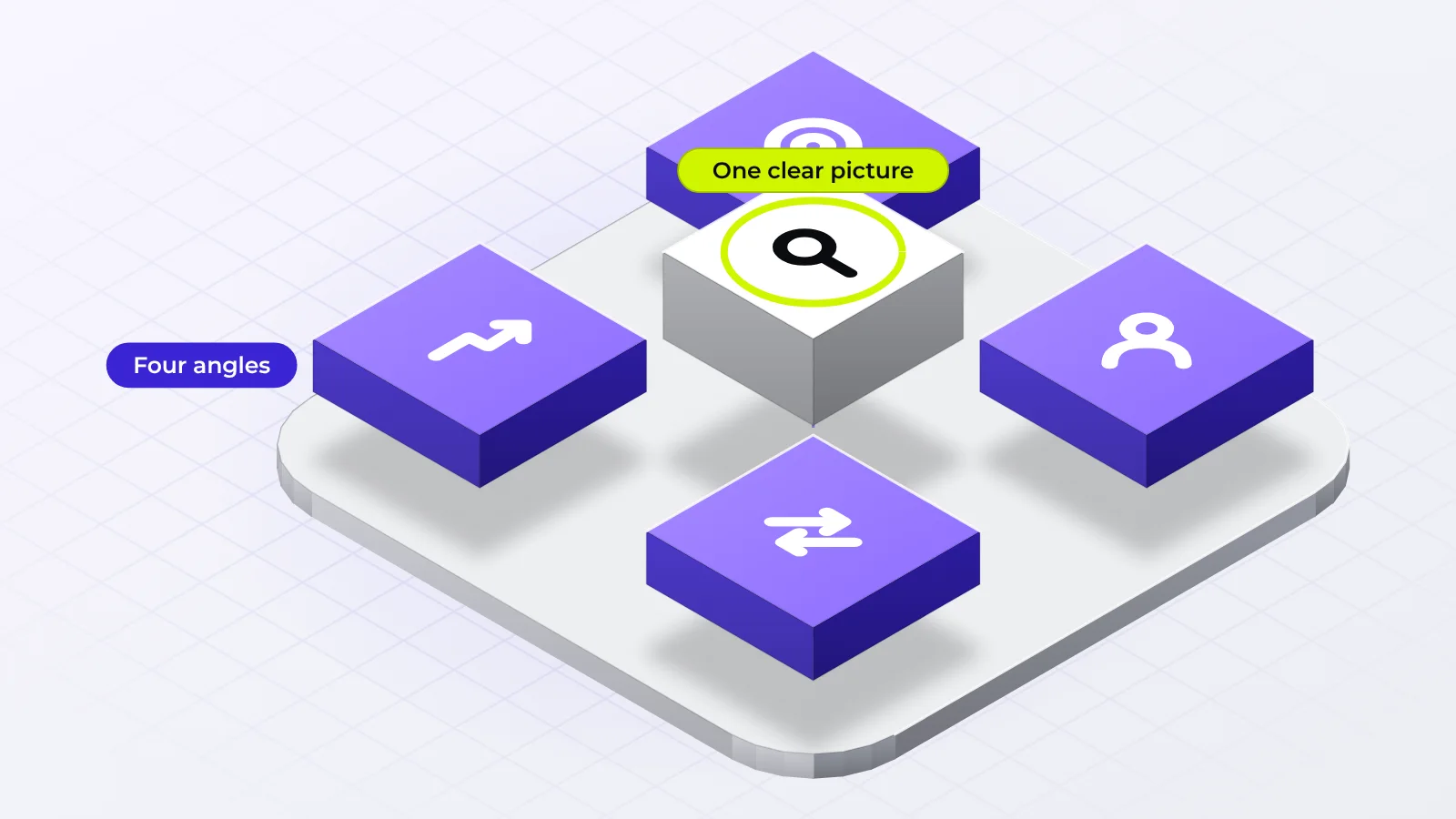
Competitor analysis usually means looking at competitors, which is one angle of four. A decision about pricing, positioning or a new offer needs all four, because each one fails in a different way when it's skipped.
1. Market: is the demand real, and is it moving?
How many businesses could buy this, how is that number changing, and what's pushing it? For UK B2B, the Department for Business and Trade's business population estimates are a better starting point for a bottom-up estimate than a press-release headline. At the start of 2025 there were 5.7 million private sector businesses, but 4.27 million of them had no employees. Of the rest, 220,085 had 10 to 49 employees and 38,435 had 50 to 249. The 2026 edition is provisionally scheduled for 5 November 2026, so check for it before you quote these. Skip this angle and you get the confident market size nobody can trace.
| No employees (4,272,535) | 75.1% |
|---|---|
| 1 to 9 employees (1,150,875) | 20.2% |
| 10 to 49 employees (220,085) | 3.9% |
| 50 to 249 employees (38,435) | 0.7% |
| 250 or more employees (8,335) | 0.15% |
Source: Department for Business and Trade, Business population estimates for the UK and regions 2025, 2 October 2025. Counts are DBT's, in brackets. Shares are ThriveFinity's arithmetic on those counts (total 5,690,265). Highlighted rows are the 10 to 250 staff range this guide is written for. Chart by ThriveFinity.
2. Buyers: who decides, and what are they comparing you with?
The people who sign, the people who use the product, and the alternatives they actually consider, including doing nothing. Your own sources matter most here: win and loss notes, call recordings, support tickets and the questions prospects ask before they buy.
Many buyers would rather do this comparison alone. In a Gartner survey of 632 B2B buyers (August to September 2024, published June 2025), 61% said they prefer an overall rep-free buying experience. And 69% reported inconsistencies between a supplier's website and what its sellers told them. That second figure is a CI finding about yourself as much as about rivals. Buyers notice when the story doesn't hang together. Leave the buyers out and you end up with messaging aimed at the user when the budget-holder is the one deciding.
| Prefer an overall rep-free buying experience | 61% |
|---|---|
| Report inconsistencies between a supplier's website and its sellers | 69% |
Source: Gartner Sales Survey, 632 B2B buyers, fieldwork August to September 2024, published June 2025. Buyer survey from an analyst firm, not a controlled test. Chart by ThriveFinity.
3. Competitors: where do they win, and where do they lose?
A short, honest account of why buyers choose each alternative, what they promise, what they charge and which of their claims you can beat with evidence. A feature grid on its own won't tell you that. Without it you get the we have no real competitors slide.
Timing matters too. 6sense's 2025 buyer survey, a vendor survey of nearly 4,000 B2B buyers, found they first contacted a seller about 61% of the way through their journey, and 77% said their first vendor conversation was with the eventual winner. My reading is that by the time a competitor shows up in your pipeline, the buyer may already have made up their mind.
4. Trends: what's changing around all of you?
Regulation, technology, buyer behaviour and channel shifts that affect every player at once. A new reporting rule, a change in how buyers research suppliers (AI assistants are an obvious one), or a procurement framework opening up. Ignore it and you'll be defending last year's position.
For trends, a short list of named sources beats a wide news feed. Pick the regulator for your sector, one or two trade publications your buyers actually read, and the government consultations that touch your market. Add a line to the log when a consultation opens or closes, because that's when buyers start asking questions.
Which UK Sources Hold Up?
You don't need paid tools to start. The sources below are public, and most are free. What matters is recording what you found, where and when, so the next review can see what changed.
Companies House
For any UK competitor, Companies House lets you see some details for free, including registered address, date of incorporation, current and resigned officers, document images, previous company names and insolvency information. You can also set up free email alerts for when a company updates its details, for example a change of director or address. Follow your five closest competitors. It takes a few minutes and runs itself.
Some smaller companies file limited accounts, so read missing detail as missing, and don't treat it as a signal either way. If you haven't used the search before, this short walkthrough from a company formation agent covers searching by name or number, filing history and the advanced filters:
Contracts Finder and Find a Tender
If you sell to the public sector, or compete with firms that do, procurement notices are some of the best evidence you'll find. Contracts Finder covers contracts worth over £12,000 including VAT, including details of previous tenders and contracts. GOV.UK says high value contracts, usually above £139,688 including VAT, use the Find a Tender service. Scotland, Wales and Northern Ireland have their own sites: Public Contracts Scotland, Sell2Wales, and eSourcing NI with eTendersNI.
Award notices show who's winning which frameworks, and at roughly what scale. Bid consultancy Thornton & Lowe has a short explainer on the newer data that public bodies now publish, such as payment, spend and contract performance reporting, and how suppliers can use it for competitor analysis:
Competitor websites, then and now
Capture competitor pricing and product pages on a fixed date each month. To see how a competitor's positioning has moved, the Internet Archive's Wayback Machine lets you visit archived versions of websites. It doesn't cover everything. It doesn't archive pages that require a password, and some sites are excluded at the owner's request.
Job adverts
A rival hiring field sales in Manchester, or a head of partnerships, tells you more about next year's plans than this year's press release. Save the advert, because it'll disappear when the role is filled.
Review sites, case studies and trade press
Reviews show what customers praise and complain about, in their own words. Note which claims competitors back with named customers and which they don't, because unbacked claims are where your proof can win. Speaker lists, award entries and trade press interviews are where competitors say things in public that they'd never put on their website. Note the date and the outlet, and treat it as their own claim until something independent backs it up.
Search demand
Google Trends gives a directional view of whether interest in a category is growing, flat or seasonal. Read it properly, though. Google's own Trends FAQ explains that the data is a sample, normalised to the time and place of the query, and scaled from 0 to 100. It shows relative interest. It won't tell you how many people searched.
Your own pipeline
Lost-deal reasons, the competitor named on each loss, and the objections that come up in the first call. This is the source most companies already own and least often read, so it gets its own section.
How Do You Use Win-Loss Analysis for CI?
Win-loss analysis means asking recent buyers, both the ones who chose you and the ones who didn't, why they decided as they did. It's the most direct evidence you'll get about how you compare.
Start small. After each closed deal, won or lost, record three things in your CRM:
- which alternatives the buyer considered
- the main reason for the decision
- one thing they said in their own words
Then, once a quarter, ask two or three lost buyers for a 15-minute call. Ideally someone who wasn't on the deal runs it, so the buyer isn't critiquing the person in front of them.
The first step matters more than it looks. In the Crayon survey, 44% of respondents said their teams lack CRM visibility into which competitors show up in deals. If you don't record who you met, you can't tell which rival is hurting you. A single required field on the deal record closes most of that gap, and it costs nothing.
What Does Ad-Hoc Research Usually Miss?
The same blind spots come up again and again when a team researches its own market. Watching for them is most of the work.
- The alternative you don't think of as a competitor. A spreadsheet, an in-house team, a generalist consultancy or simply waiting. Buyers compare you with what they'd otherwise do.
- Confirmation. Searching for evidence that the plan is right. Before you start, write down what you'd expect to find if the plan were wrong, then look for that.
- Stale numbers. A market figure from three years ago, quoted as if it were current. Record the date of every number you use.
- Secondary sources passed off as primary. A blog post quoting a report isn't the report. Go back to the original and check it says what the summary claims.
- One person's view. Sales, marketing and delivery each see a different market. A review that only hears one of them misses the other two.
- An unchecked AI summary. AI tools can state things that aren't true, so use them to suggest where to look and check every fact against the original page.
That last one has a flip side. Your buyers are asking those same tools about you and your rivals, so it's worth knowing what they say. Our guide to running an AI visibility check shows how to do that by hand.
How Should You Grade the Evidence?
Not every finding deserves the same weight. A simple grading habit stops a guess being repeated as a fact in the next board pack. For each finding, note:
- Source: named and traceable, so someone else can check it.
- Date: when the source was published and when you checked it.
- Method: for any number, how it was produced. A survey of whom, and how many.
- Confidence: high, medium or low, with one line on why.
Here's how that plays out with the sources in this guide. A government statistic with a published method is strong. A vendor survey, like the Crayon and 6sense reports above, is useful but directional, because the people running it also sell into the market. A forum post is one person's experience. It's good for colour and can't be your proof.
Grading also forces you to separate what you saw from what you concluded:
- A fact: Competitor X's pricing page dropped its entry tier on 3 March. It has a source and a date.
- An inference: Competitor X is moving upmarket. It might be right, but it belongs in the report labelled as a judgement, next to the facts that support it, so the leadership team can disagree with the reasoning without arguing about the evidence.
Competitor X here is made up, but the habit is the same for any real one.
When a decision rests on a finding, everyone in the room should be able to see how solid that finding is. We use the same idea in our own methodology, where every claim in a deliverable carries a source and a grade.
What Should a Competitive Intelligence Report Include?
A CI report should answer one decision and show its working. Use this as a template:
| Section | What goes in it |
|---|---|
| Decision and answer | The decision this informs and the recommendation, in two or three sentences |
| Alternatives overview | Competitors and other options buyers consider, with a one-line summary of each |
| Offer and pricing | What each sells, at what price and on what terms, with capture dates |
| Positioning and messaging | How each describes itself and who it targets |
| Recent moves | Hiring, launches, wins, funding and leadership changes since the last review |
| Buyer evidence | What buyers and lost deals say about the alternatives |
| Threats and opportunities | What changes the decision, graded by evidence strength |
| Case against | The strongest argument against the recommendation, written down |
| Sources and review date | Every source with its date, and when this report should be refreshed |
For a ready-made list of what to check before you write it, use the free competitive intelligence audit checklist. It covers 23 checks across six sections.
Which CI Tools Are Worth Paying For?
Start free. Buy a tool when the manual routine works and takes too long.
- Free: Companies House, Contracts Finder and Find a Tender, competitor websites with the Wayback Machine, job adverts, review sites, Google Trends and your own CRM loss notes.
- Paid, for scale: search visibility tools (to see which keywords competitors rank for), web traffic estimators, dedicated CI platforms that alert you to competitor changes, and AI visibility tools that show which companies AI assistants recommend in your category. Our guide to measuring AI share of voice explains the maths behind those.
Before you buy, ask three things. Which of my fixed sources does it cover, and which does it miss? (No tool can read your lost-deal notes unless someone writes them down.) Where does its data come from, and how often is it refreshed? And who on my team will read the alerts each week? If nobody can answer the last one, wait. I'd get the habit working on free sources for a quarter first, so you know exactly what you want a tool to save you.
What Review Rhythm Will a Leadership Team Actually Keep?
The best rhythm is the one that survives a busy quarter. For most companies of 10 to 250 people, I'd suggest this:
- Monthly, 60 to 90 minutes, one owner. Check the fixed list of competitor pages, procurement notices, Companies House alerts and job adverts. Log changes. Flag anything that affects a live deal or a pricing decision.
- Quarterly, half a day, leadership team. Review the four angles together. What changed in the market, in buyers, in competitors and in the wider environment? Which decisions should change as a result?
- Before any major decision. A launch, a price change, a new market or a repositioning gets a focused review of the evidence behind it, with the strongest case against it written down. Our guide to testing an offer or price change covers that sequence.
Who should the owner be? In a company this size it's usually the marketing lead, or the founder if there isn't one. The owner doesn't do all the gathering. Sales should feed in what they hear on calls, delivery should flag what clients say about alternatives, and finance should spot a competitor's price showing up in a renewal negotiation. The owner keeps the log, runs the monthly check and brings the quarterly picture to the leadership team.
Keep the log simple. A shared spreadsheet with five columns is enough: date, source, what changed, which angle it belongs to, and which decision it might affect.
How Do You Use CI in Your Own Marketing Without Misleading Buyers?
CI often ends up on your website or in a sales deck, as a comparison table or a why us page. At that point it's advertising, and the rules change.
The UK's CAP Code says marketing that compares you with an identifiable competitor must not mislead, and must compare products meeting the same needs or intended for the same purpose. Rule 3.34 is specific about how:
They must objectively compare one or more material, relevant, verifiable and representative feature of those products, which may include price.
In practice that means dated captures of the competitor's own pages, like-for-like comparisons, and no guessing at prices they don't publish.
Your own claims need the same discipline. If your positioning says fastest or most experienced, your CI file should hold the evidence. Our guide to proof claims on B2B websites covers how to back them, and B2B positioning for established companies covers turning what you've learned into a position you can defend. If the intelligence points to a different target segment altogether, the STP guide for B2B is the next read.
Where ThriveFinity Fits
An internal rhythm is enough for most of the year. An outside view earns its fee when the cost of being wrong is high and the team is close to the answer, such as before a pricing change, a strategy reset, a new market entry or a repositioning that will drive next year's spend. It rarely finds a source you couldn't. Its value is that someone with no stake in the plan does the uncomfortable part: tests the evidence, writes down the case against, and puts their name to the answer.
That's what a Decision Brief is. It costs £749 plus applicable taxes on a 48-hour target, and tests one go-to-market decision from four angles (market, buyers, competitors, trends) with a signed seven-block Decision Card, graded evidence and a 90-day plan. If you're not sure where to begin, start with a free First Signal.
We're not the right choice if you need a standing CI team, daily battlecard updates for a large sales floor, or a monitoring platform. A dedicated CI tool or an in-house analyst suits that better. And whoever you hire for this, check they work inside the legal and ethical limits set out above.
Sources
- legislation.gov.uk. The Trade Secrets (Enforcement, etc.) Regulations 2018, regulations 2 and 3. Checked 20 October 2026.
- EUR-Lex. Directive (EU) 2016/943 on the protection of undisclosed know-how and business information, Article 3. 8 June 2016. Checked 20 October 2026.
- legislation.gov.uk. Computer Misuse Act 1990, section 1. Checked 20 October 2026.
- Information Commissioner's Office. What is personal data? Checked 20 October 2026.
- GOV.UK. Get information about a company (Companies House). Checked 20 October 2026.
- GOV.UK. Contracts Finder and Find a Tender. Checked 20 October 2026.
- Department for Business and Trade. Business population estimates for the UK and regions 2025. 2 October 2025. The 2026 edition is provisionally scheduled for 5 November 2026.
- Internet Archive. Wayback Machine general information. Checked 20 October 2026.
- Google. FAQ about Google Trends data. Checked 20 October 2026.
- Crayon. 2025 State of Competitive Intelligence report (400+ responses from B2B SaaS CI professionals, December 2024 to February 2025). 2025. Vendor survey.
- Gartner. Gartner Sales Survey Finds 61% of B2B Buyers Prefer a Rep-Free Buying Experience (632 buyers, August to September 2024). 25 June 2025.
- 6sense. The B2B Buyer Experience Report for 2025. 2025. Vendor survey.
- ASA and CAP. CAP Code section 3, rules 3.32 to 3.34. Checked 20 October 2026.