

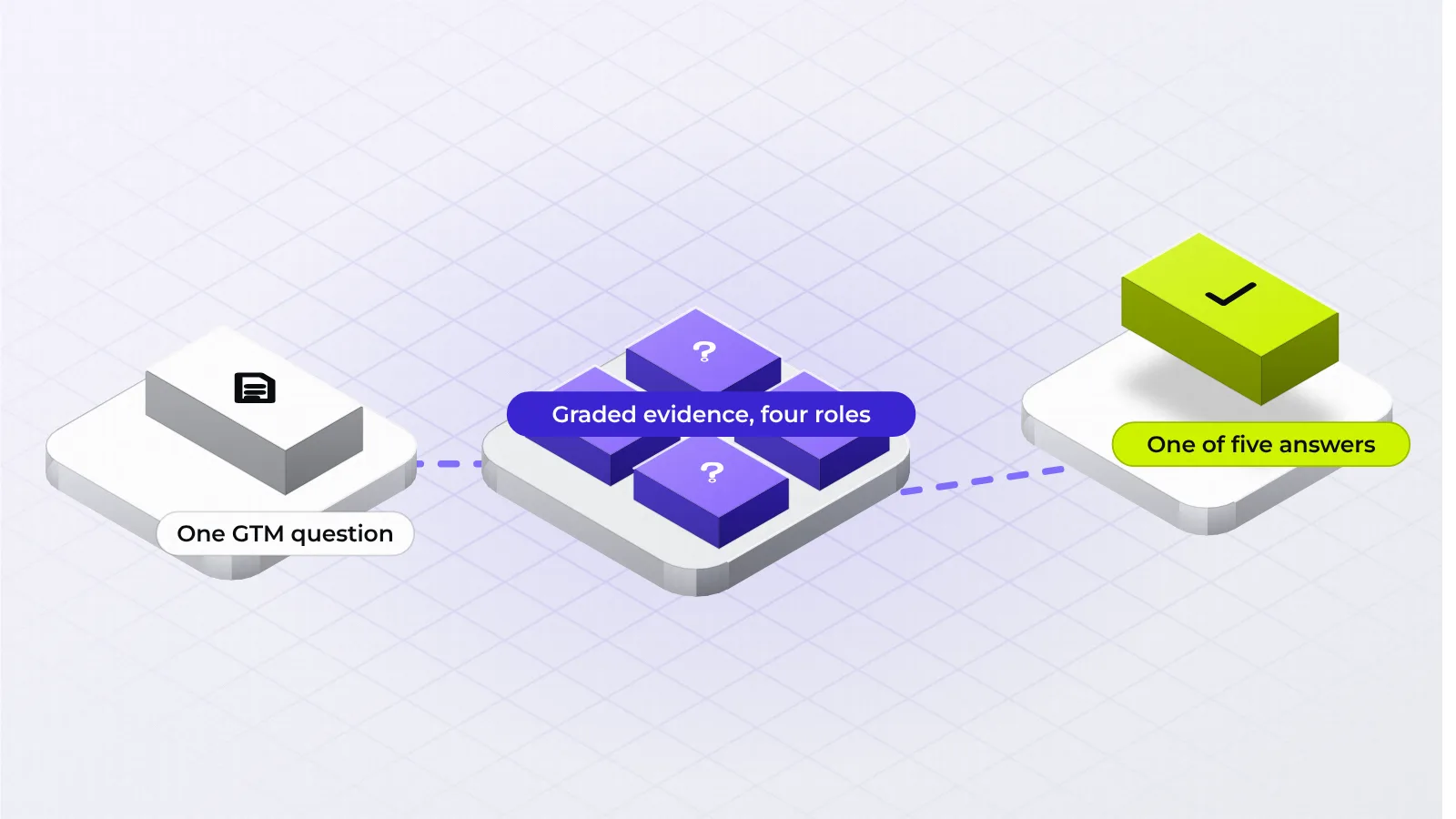
Every go-to-market framework we have seen ends the same way: a deck. Segment on one slide, positioning on the next, channels, pricing, messaging, a timeline. All of it can be filled in carefully and the team still leaves the room without knowing whether to launch. The deck describes the plan. It does not decide it. A decision rule is different: it is one sentence per answer, written before the evidence is gathered, saying what would have to be true for that answer to be given. This page gives you ours.
It is for founders and go-to-market leads at B2B companies who are about to commit a quarter and some money to a launch, a new market or a repositioning, and who would rather know now than find out in month three. It explains why a slide is not a decision, sets out the five-line rule, the evidence grades and buyer roles that feed it, what each answer obliges you to do, and one anonymised run where the honest answer was not the one the client hoped for.
Why a Slide Is Not a Decision
A framework asks "have we thought about X?" and a complete deck answers yes to every X. That is useful housekeeping and it has two failures as a decision. First, every box can be filled with evidence of any quality, and a slide does not show the difference between a grade A source and a founder's hunch. Second, the answer is implied by the act of finishing the deck. Nobody builds forty slides to conclude Stop.
A decision rule fixes both by being written first. Before anyone reads a market report, the rule says what evidence would produce each of the five answers and what would disqualify a Go. The research then has a job, which is to find out which line of the rule the evidence satisfies, rather than to decorate a conclusion. If the evidence lands on Stop, the rule was agreed in advance and Stop is what the Brief says.
The Five-Line Rule
The public vocabulary has five answers. The rule behind each is one line.
- Go. Every decision-critical claim rests on grade A evidence, or grade B with no contradiction, and none of the four buyer roles raises an objection the evidence cannot answer. The evidence supports the move as planned.
- Go With Conditions. The case holds except for named gaps, each of which can be closed by a specific, cheap test or action before the spend. Proceed once those are closed, not before.
- Change Course. The goal is sound but the chosen route fails a kill criterion: the segment, the wedge, the price or the channel is contradicted by grade A or B evidence, or a buyer role blocks it. Keep the goal, change the route.
- Stop. The decision-critical claims rest on grade D or E evidence and the buyer roles do not buy, with no cheap test that could change that. The evidence is against it, and we say so.
- Wait. The claims that matter cannot be graded above C because the thing that would settle them has not happened yet, and there is a named event or date that will. Too early to call, with what to watch written down.
Three things in that list do the work. The grade thresholds, which stop weak evidence being counted as strong. The buyer roles, which stop the offer being judged only by the people who built it. And the kill criteria, the conditions written inside Change Course and Stop, which make a later reversal the application of a rule rather than a loss of nerve.
The Grades Behind It
Every claim in a Brief carries a grade from A to E, the same scale our research engine applies and the one on the methodology page:
| Grade | Meaning | What it may carry |
|---|---|---|
| A · Corroborated | Multiple high-authority, recent, independent sources fully corroborate the claim. | Can carry a decision-critical claim on its own. |
| B · Authoritative | One or two authoritative, recent sources, no significant contradictions. | Strong support. Named and dated in the deliverable. |
| C · Partial | Credible but older than 12 months, or partial coverage, minor contradictions. | Used with the gap stated. Never dressed up as A or B. |
| D · Weak | Weak sources, significant gaps, or major contradictions present. | Directional at best. Flagged wherever it appears. |
| E · Speculation | Speculation only: no retrieved evidence behind the claim. | Named as speculation. Never used as support. |
Source: the ThriveFinity evidence scale, as published on /methodology and applied in every Decision Brief.
The rule's first line depends on this scale. "Decision-critical" means a claim without which the recommended path collapses: that the segment exists at a size worth the effort, that it buys comparable things, that the wedge is not already occupied, that the price is survivable. Each of those needs an A, or a B with nothing contradicting it, before a Go can be written. A C is used with its gap stated. A D or E can appear in the Brief, flagged, but it can never hold up the decision.
The second input is the four buyer roles. Each offer is cross-examined from the point of view of the budget holder, the technical evaluator, the day-to-day user and the final decision-maker. Each role asks the questions that role would ask in a real purchase, and the evidence has to answer them. An objection no evidence can answer is a condition at best and a kill criterion at worst.
What Each Answer Obliges
An answer is only useful if it tells you what to do on Monday. Each of the five carries an obligation.
- Go obliges you to launch on the plan as written and to watch the two or three things the Brief names in its "watch" block, because a Go is a statement about today's evidence, not a guarantee.
- Go With Conditions obliges you to run the named tests first. The conditions are usually the cheapest real-buyer tests available, the kind described in how to test an offer in a new market, and the Brief costs them so the sequence is clear.
- Change Course obliges you to keep the goal and drop the route. The Brief says which element failed and what the evidence points to instead. It does not oblige you to take our alternative, only to stop treating the failed route as live.
- Stop obliges you to stop spending on this offer in this form. It is the answer nobody orders a Brief hoping for, and it is the one that saves the most money when it is right.
- Wait obliges you to do nothing expensive until a named event, and to re-read the evidence when it happens. It is not permission to drift. The "watch" block carries the date or trigger.
The seven blocks of the Decision Card are the answer and its obligations written out: the decision, what the evidence shows, the recommended path, why, don't, test next, watch. The "don't" block is the kill criteria restated as things not to do. The "test next" block is where Go With Conditions lives.
One Anonymised Run
The walk-through on the Decision Brief page is a real run with the client's details removed. The question was which audience segment, differentiation claim and proof architecture a landing page and go-to-market messaging should commit to, given the market, competitive and regulatory conditions. The evidence included a dated gap left by two incumbents in a specific high-risk, cross-border segment, graded from named sources. The wedge that best used that gap also carried a real reputational association risk, and the Brief said so rather than softening it. Claims the evidence did not support were left out of the Decision Card entirely rather than hedged into it.
Read against the rule, a run like that cannot be a plain Go, because a reputational association risk is exactly the objection a final decision-maker raises and the evidence can only partly answer it. It is not a Stop either, because the gap was real and dated. The published walk-through does not state the verdict, so we will not state it here. What it does show is the shape of the rule at work: a wedge carried with its risk named, claims the evidence did not support left out, and a signed card the client could act on rather than a deck.
Writing Your Own
You can apply the rule without us. Write the five lines above into a document before your next piece of market research. Define "decision-critical" for your decision in one paragraph: the three or four claims that, if false, make the plan collapse. Grade every source you read on the A to E scale as you go, and do not let yourself round a C up. Then ask someone who is not on the team to play the budget holder and the final decision-maker and to object. What they cannot be answered on becomes a condition. What they cannot be answered on at all becomes a kill criterion. Whichever line the evidence then satisfies is your answer, and you wrote the line before you knew.
The parts that are harder to do alone are the honesty of the grading, the independence of the buyer roles and having a named person sign the result. That is what the Brief adds, on a 48-hour target, with a seven-block Decision Card plus supporting documents and a 90-day plan for the lens you choose. The rule itself is free to copy.
Limits of This Page
- The rule is ours. It is one way to force a decision from a framework, not the only one, and it is built for B2B offers with an identifiable buying committee.
- A Brief is desk research. It grades evidence about buyers. Proof that a specific buyer will pay a specific price comes only from real buyers, which is why Go With Conditions is the most common honest answer and why the Brief lists the cheapest tests next.
- The example is anonymised from a published walk-through. No client is named and no figures from the run are reproduced.
- No third-party statistics appear on this page. Errors we find are logged on the errata page.
Spotted something out of date or wrong on this page? Email om@thrivefinity.uk and we respond within 5 working days.
❓ Common Questions
What is a go-to-market decision rule?
How is this different from a go-to-market framework?
What are kill criteria?
Can I write my own?
Sources
- ThriveFinity. Methodology: the five public answers and the A to E evidence scale.
- ThriveFinity. Decision Brief: the four buyer roles, kill criteria, the seven-block Decision Card and the anonymised walk-through.