

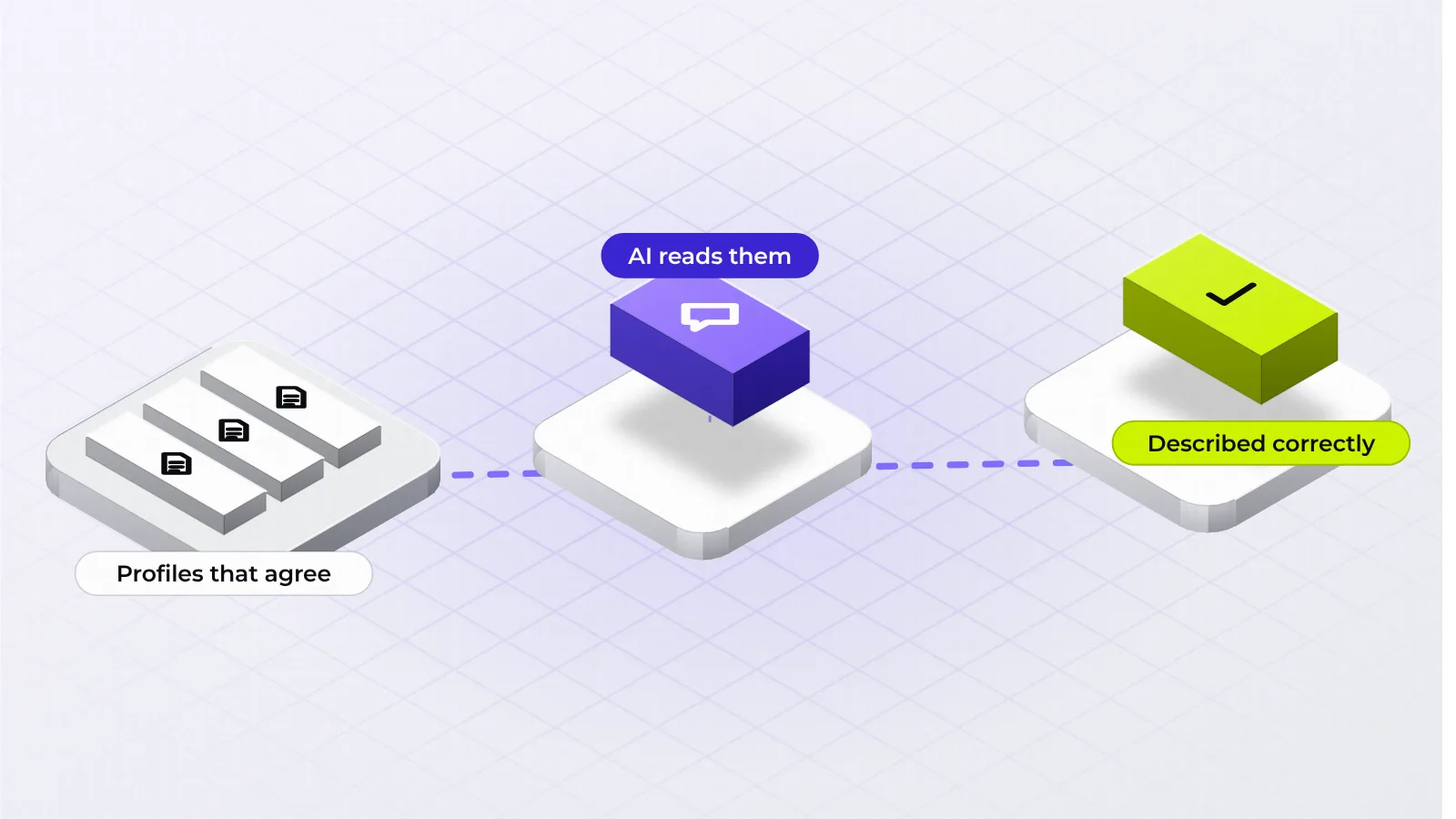
An AI assistant does not know your company. It assembles a description from a small set of public places: your site, your LinkedIn page, a Google Business Profile, directories, review sites, a knowledge base entry, the company register, and whatever else ranks for your name. When those places agree and are current, the description is right. When they disagree, are empty, or describe the company you were two years ago, the assistant guesses or repeats the stale version, and a buyer who verifies finds the mismatch. Fixing those places is the first step of any AI visibility work, and most of it is an afternoon with a spreadsheet.
This page is for founders and marketing leads at B2B companies in the UK, US, UAE, EU and Singapore who have read an AI answer about their own company and winced. It shows what we found when we read the answers about ourselves, where an assistant learns who you are, the ten places that matter most, and the audit to run before you spend anything on ranking. It is the first step in our guide to AI visibility for B2B brands.
What AI Said About Us
In our weekly run of 26 October 2026, 23 answers named ThriveFinity on the five questions that ask about us by name. All 23 were broadly right about what we do. Two of them, on ChatGPT and Claude, still described services we had retired earlier in October, with the old names and the old turnaround times, because the pages they read had not been updated and other pages still carried the old wording. One answer placed us accurately as based in India serving the UK, which is true and which we would rather say ourselves than have inferred.
The pages cited beside our own were more telling. Three directories, one of them a trade listing in India, appeared in three brand answers each. A domain broker's page offering thrivefinity.com for sale was cited. Three unrelated companies whose names begin with Thrive were cited on the cost and refund questions, and so was a site that rates companies as legitimate or scam. None of those pages is ours and all of them were shaping the answer. The full citation list is in the pages AI assistants cite about your company.
The lesson we took: an assistant answering a question about you pulls in whatever ranks for your name, including pages that are stale, wrong, or about someone else. What it says is only as good as the worst of those pages.
Where an Assistant Learns Who You Are
Two larger studies describe the same mechanism at scale, with their limits. Semrush, an SEO tool vendor, analysed over 100 million AI citations across a quarter and reported in November 2025 that Reddit and LinkedIn were among the five most-cited domains on ChatGPT, Google AI Mode and Perplexity, with Wikipedia also near the top on ChatGPT. Its March 2026 follow-up, reported by PPC Land, put LinkedIn in about 11% of AI responses across three platforms. Peec AI, an AI visibility tool vendor, reported from 30 million sources that review platforms such as G2 and Yelp appeared often in recommendation queries, as covered by Search Engine Land.
Review platforms like Yelp and G2 appeared often in recommendation queries.
Those are vendor studies with their own methods, and their category-wide shares say nothing about any one company. What they agree on with our own small run is the shape: a professional network, a knowledge base, review sites and directories, plus the company's own pages, are what an assistant reads before it describes a business. The places are few, they are public, and most are yours to fix.
The Ten Places
These are the places we check and align first, in the order they tend to matter for a B2B company. Not every one fits every company, which is why the work starts with a scored audit rather than a checklist.
- Google Business Profile. Claimed, right category, current description, logo, website link. Assistants treat it as fact.
- LinkedIn company page. The About section, specialities, website and logo. One of the most-cited domains in AI answers, and usually written years ago.
- Wikidata. An entity item with your legal name, founding date, people, website and identifiers. It is the knowledge base many systems read for "what is this company". Ours is Q141806483.
- Crunchbase. Created or claimed, description and founders aligned.
- Your sector's review site. G2, Capterra, Clutch or Trustpilot, whichever your buyers use. Claimed and aligned, with the same description as your site.
- Product Hunt, where it fits your product.
- GitHub organisation, where you publish code.
- The company register. Companies House in the UK, the MCA in India, the equivalent elsewhere. Your registered name, number and address must match what every profile says, because a careful assistant, and a careful buyer, checks.
- Your About page. Rewritten to state the facts plainly, with structured data that matches them, and a line naming the similarly named companies you are not.
- Your facts page. One public page of the facts an assistant must get right, linked from every profile. Ours is the About page plus llms.txt, which carry the same wording.
A One-Afternoon Audit
- Write the fact sheet first. One page: legal name, trading name, founding date, people, services with current names, prices, locations, markets, identifiers. Sign it. Everything else copies from it.
- Ask three assistants the five brand questions. What does the company do and for whom. Is it legitimate. What does it cost. Is there a refund or guarantee. How does the main service work. Record every cited page. The walkthrough is in how to run an AI visibility check.
- Search your own name and read page one. Anything stale, wrong or about someone else that ranks for your name is a page the assistant may read before yours. Note each one.
- Score the ten places. For each: present or missing, right or wrong against the fact sheet, linked to your site or not. A spreadsheet with three columns is enough.
- Fix what you control today. About page, LinkedIn, Google Business Profile, your review-site profile, your register entry if it has drifted. Same words everywhere.
- Request corrections where you can. Directories and listing sites usually have an edit or claim route. A domain-for-sale page or a name-collision company cannot be fixed, only outranked by pages that should rank for your name.
- Re-ask the same five questions in four weeks. Compare the answers and the cited pages line by line. Judge by the change over several runs.
Where the Service Fits
The audit above is the method behind our AI Presence service, and you are welcome to run it without us. The service version is for companies that would rather have it done in five working days: we write and sign the fact sheet with you on day one, score the 15 to 20 places an assistant reads on day two, create or claim up to 10 profiles in your name over days two to four with your logo, description and links both ways, and re-score the same places at day 30 so you can see what changed line by line. It is part of AI Visibility rather than a separate product, because presence is where the visibility work has to start. If your places already agree, you do not need it.
Limits of This Page
- Our observations are one company's brand answers from one week, 23 answers across four traceable assistants, each question asked once.
- The Semrush and Peec AI figures are vendor studies with their own methods, cited through their own publication and through press reports checked on 6 November 2026. Category-wide citation shares do not predict any single company's answers.
- The ten places are our working list for B2B companies. Which of the 15 to 20 places matter for a given company comes out of the audit, not from this page.
- Nothing here promises that an assistant will name you. It is about being described correctly when it does. Errors we find are logged on the errata page.
Spotted something out of date or wrong on this page? Email om@thrivefinity.uk and we respond within 5 working days.
❓ Common Questions
What does "AI Presence" mean?
Is this the same as SEO or GEO?
Can I do this myself?
How do I know if AI is describing me wrongly?
Sources
- ThriveFinity. AI Visibility panel v3, weekly run of 26 October 2026, brand questions (23 answers) and the pages cited beside our own. Method on the methodology page.
- Semrush. The Most-Cited Domains in AI: A 3-Month Study. 10 November 2025. Vendor study, over 100 million citations. Re-fetched 21 November 2026.
- PPC Land. LinkedIn ranks #2 in AI citations: what 89K URLs reveal about B2B visibility. Report of Semrush's March 2026 study. Re-fetched 21 November 2026.
- Search Engine Land. AI search engines cite Reddit, YouTube, and LinkedIn most: Study. Report of Peec AI's 30-million-source analysis, 2026. Re-fetched 21 November 2026.
- Wikidata. ThriveFinity (Q141806483). Our own entity item.