

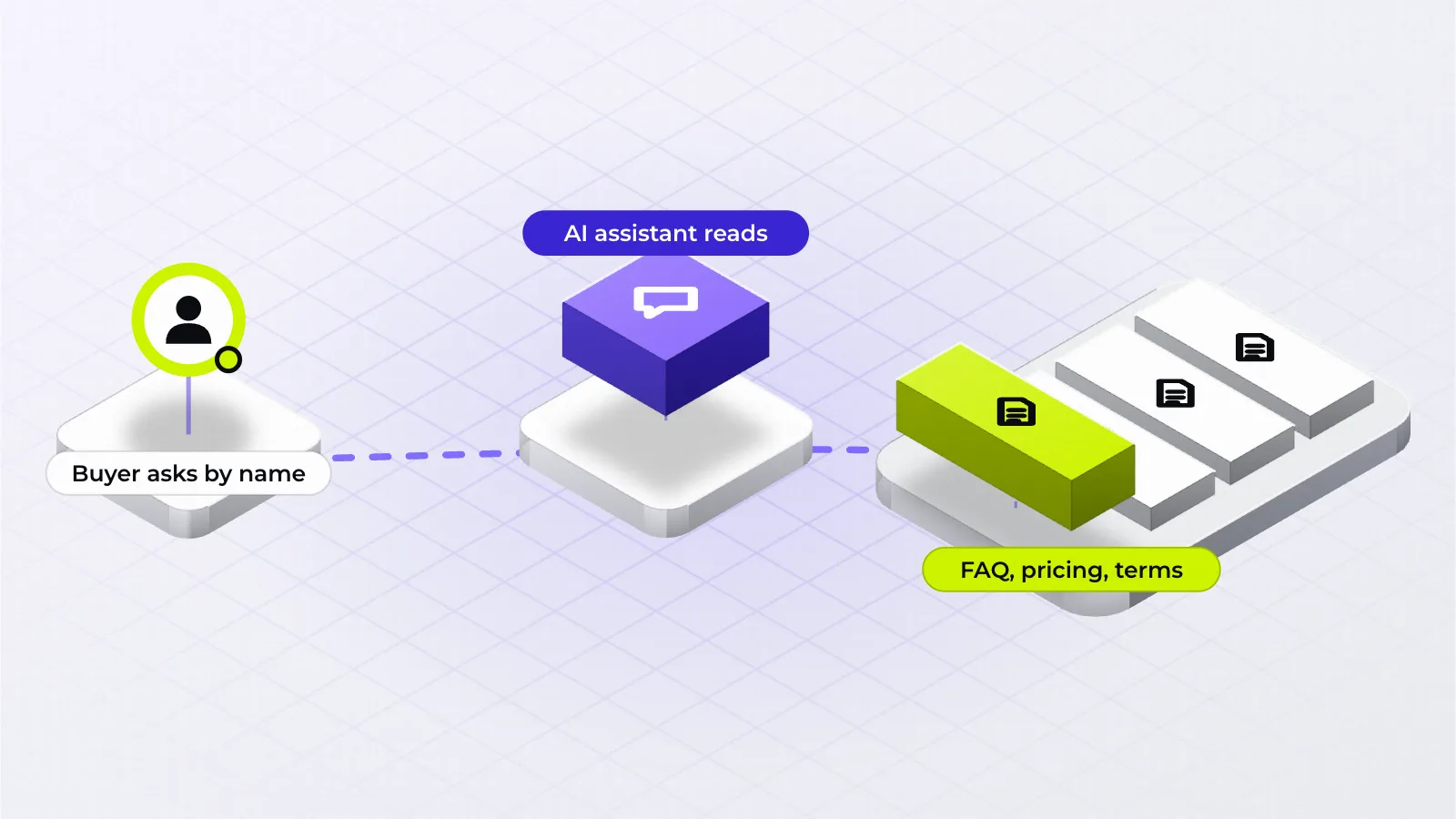
When a buyer asks an AI assistant about a company by name, the assistant doesn't read the homepage and stop. In our run of 26 October 2026, the pages it cited about us were the FAQ, the terms, the pricing page, the refund policy, the complaints page and a comparison page. The homepage appeared too, but as one source among a dozen. The pages most companies treat as housekeeping are the ones that describe them to AI.
This page is for founders and marketing leads at B2B companies who want to be described accurately when someone asks ChatGPT, Claude, Gemini, Perplexity or Google AI Overviews about them. It uses only our own site as the example, because that is the only site whose pages we can audit against what was cited. One company, one week, so read it as a pattern to test on your own name. The wider picture of what the same run cited across all questions, engine by engine, is in where each AI assistant gets its answers.
How We Checked
Our weekly panel asks 46 locked questions on five assistants, with web search on, each question once. Five of the 46 name ThriveFinity: what it does and who it's for, whether it's legitimate, what it costs, whether it offers a refund, and how one specific product works. The other 41 name nobody. On 26 October that produced 219 answers. We then listed every link in every answer that pointed at thrivefinity.uk and counted, for each page, the number of answers that cited it.
Twenty-five of the 219 answers cited at least one page on our site. Twenty of those were answers to the five brand questions, which were answered 23 times in all, and the other five were answers to questions that named no company. ChatGPT cited us in 7 answers, Perplexity in 7, Claude in 6 and Google AI Overviews in 5. Gemini cited us in none, because every link Gemini returns is a Google redirect address and can't be traced to a page.
Which Pages Were Cited
Across the 25 answers, 25 different pages on our site were cited at least once. The ones cited most were the FAQ (10 answers), the homepage (9), the terms (9), a comparison page against one named alternative (6), and then a group at 5: the pricing page, the complaints page, the agency partner page, the free check page, the ROI calculator and one blog post on testing a price change.
| FAQ | 10 answers |
|---|---|
| Homepage | 9 answers |
| Terms | 9 answers |
| Comparison page (vs one named alternative) | 6 answers |
| Pricing | 5 answers |
| Complaints policy | 5 answers |
| Agency partners | 5 answers |
| Free check (start page) | 5 answers |
| ROI calculator | 5 answers |
| Blog: testing a price change | 5 answers |
| Refund policy | 3 answers |
Source: ThriveFinity AI Visibility panel v3, weekly run of 26 October 2026, 46 prompts on five assistants, each asked once, 2026. An answer can cite several pages. Fourteen further pages were cited in 1 to 4 answers each, including the offer validation page (4), about, company and contact (3 each). One week, one company. Chart by ThriveFinity.
Notice what isn't near the top. The service pages that we spend the most time on were cited in one to four answers each. The pages cited most are the ones that state a plain fact a buyer might ask about: a price, a rule, a comparison, a definition of who we serve.
Question by Question
The pattern is clearer when you match each brand question to the pages it pulled. The table lists the pages cited in at least two of that question's answers.
| Question asked | Answers (named us / cited our site) | Our pages cited in 2 or more answers |
|---|---|---|
| What does ThriveFinity actually do and who is it for? | 5 / 5 / 4 | Homepage 4 · FAQ, about, company, free check 2 each |
| Is ThriveFinity legit? Reviews of ThriveFinity | 4 / 4 / 4 | FAQ 3 · homepage, comparison page, terms, complaints 2 each |
| How much does ThriveFinity cost? | 4 / 4 / 4 | Homepage 3 · pricing, comparison page, terms, FAQ, free check 2 each |
| Does ThriveFinity offer a refund or money-back guarantee? | 5 / 5 / 4 | Refund policy 3 · terms 2 |
| How does ThriveFinity's paid verdict work and how quickly do you get results? (prompt paraphrased: it names a tier retired in October) | 5 / 5 / 4 | Offer validation page 3 · comparison page, terms, FAQ, pricing 2 each |
Source: ThriveFinity AI Visibility panel v3, weekly run of 26 October 2026. Answers column shows answers returned, answers naming ThriveFinity, answers citing a thrivefinity.uk page. Gemini answered but its links can't be traced.
Each question went to the page that answers it, and then to the terms and FAQ as a second opinion. The refund question went to the refund policy. The cost question went to pricing and to a comparison page, which also lists prices. The legitimacy question went to the FAQ, the terms and the complaints page, which is where a careful human would look too. The one engine-level change we saw against our 18 October baseline was on exactly these two questions: Is ThriveFinity legit? and How much does ThriveFinity cost? each lost one assistant that had named us two weeks earlier. One run can't say why.
What Was Cited Beside Us
The brand answers also cited pages we don't control. Three directories appeared in 3 of the 23 brand answers each: a trade listing site in India, an agency directory, and a domain broker's page offering thrivefinity.com for sale. LinkedIn, Clutch and Reddit appeared in 2 each. Three unrelated companies whose names start with Thrive were cited on the cost and refund questions, and so was a scam-checking site. On the legitimacy question one answer cited our own mail-policy subdomain, a duplicate of the main site that we hadn't redirected.
None of that is unusual for a small company. It shows that an assistant answering a question about you pulls in whatever ranks for your name, including pages that are stale, wrong or about someone else. Representation accuracy, meaning how correctly the answer describes you, depends on those pages as much as on yours. One ChatGPT answer in the same run described us accurately as a close match for slide-by-slide claim checking but based in India rather than the UK, which is true (we are registered in Chennai and serve the UK, US, UAE, EU and Singapore). The point is that it had to work that out from several sources, and a stale directory could just as easily have told it something else.
When the Question Names Nobody
On the 41 questions that named no company, our site was cited in 5 answers, and the pages were different: a service page twice, the go-to-market service page once, a blog post about investor checks once, the investor page once, a comparison page once and a client case study once. These are the pages that argue for a category or show a worked result. So the split in one line: brand questions cite the pages that state facts about you, unbranded questions cite the pages that make a case. Both matter, and they are written differently.
What It Suggests
What we observed. One company, 25 answers across four traceable assistants. The pages cited for brand questions were, in order, the FAQ, homepage, terms, a comparison page, pricing, complaints and refund policy. Service pages were cited mostly on unbranded questions. Third-party directories, a domain-for-sale page and unrelated companies with a similar name were cited next to us.
What it suggests. The pages that describe you to an AI assistant are the ones that answer a buyer's plain questions. If your FAQ is thin, your terms are unreadable, your pricing page hides the currency or your refund rule lives in a PDF, the assistant will still answer, from whatever else ranks for your name. That's a hypothesis from one run. Google's own guidance on helpful content asks whether a page provides original information and whether a reader leaves having learned enough to reach their goal, and that is a fair test to apply to a FAQ or a policy page as much as to an article.
Does the content provide original information, reporting, research, or analysis?
What to do next. Audit the pages below in the order given, then check the third-party pages that rank for your name. The engines also need to be able to reach the pages: Google requires a page to be indexed and eligible for a snippet to appear as a supporting link, and OpenAI's documentation says sites opted out of its search crawler will not be shown in ChatGPT search answers. The access checks are listed in the sibling analysis, so they aren't repeated here.
What to Fix First
- Write the FAQ as the questions buyers ask about you. What do you do and for whom, what does it cost, how long does it take, what if it goes wrong, how do you compare with the obvious alternative. One question per entry, answered in the first sentence, with a date where a fact can change. Our FAQ was the most cited page in the run, and it's written that way.
- Put the price, the currency, the tax rule and the refund rule on pages, not in PDFs. The cost question went to the pricing page and to a comparison page. The refund question went straight to the refund policy. If those pages don't state the rule in plain words, an assistant will take it from somewhere else.
- Make the terms and complaints pages readable. They were cited on the legitimacy, cost and refund questions. A named legal entity, a registered address, a date and short sections headed by the question they answer turn a legal page into a source.
- Keep one description of the company everywhere. The same one-line description, markets, address and founder on your site, LinkedIn, the directories and any review profile. Our run cited three directories beside our own pages. Aligning those is the first step of our AI Presence service, and you can do it yourself with a spreadsheet and an afternoon.
- Search your own name and read page one. A domain-for-sale page and three unrelated Thrive companies were cited on our brand questions. Anything stale, wrong or ambiguous that ranks for your name is a page the assistant may read before yours. Fix what you control, request corrections where you can, and publish the pages that should outrank the rest.
- Make every claim on those pages checkable. A price with a date, a turnaround with its conditions, a guarantee with its trigger. The method is in proof claims on B2B websites.
Then re-run the same brand questions on the same assistants a week later and compare page by page. One run is a single draw, so judge the change in counts over several weeks, not in one answer.
Limits of This Page
- One company's site, one run, five brand questions and 41 unbranded ones, each asked once per assistant. Four assistants were API calls with web search on, not the consumer apps, and Google AI Overviews came through a search-results data provider.
- A citation shows that an assistant linked a page. It doesn't show how much of the answer came from that page, and Gemini's sources can't be seen at all.
- Our site is small and has a FAQ, pricing, terms and comparison pages written as answers. A site without those pages would produce a different list, which is partly the point.
- The two brand questions that lost an assistant against the 18 October baseline are within what sampling noise can produce. We report the change and don't explain it.
- Documentation from Google and OpenAI was checked on 30 October 2026 and can change. Errors we find are logged on the errata page.
Spotted something out of date or wrong on this page? Email om@thrivefinity.uk and we respond within 5 working days.
❓ Common Questions
Which pages should I fix first if AI describes my company wrongly?
Do AI assistants read terms and conditions pages?
Why was a domain-for-sale page cited for questions about us?
Sources
- ThriveFinity. AI Visibility panel v3, weekly run of 26 October 2026 (46 prompts, five assistants, 230 requests, 219 answers) and the 18 October 2026 baseline. Own-page citation counts recomputed per question from the run file on 30 October 2026. Method on the methodology page.
- Google Search Central. Creating helpful, reliable, people-first content. Fetched 30 October 2026.
- Google Search Central. AI features and your website. Fetched 30 October 2026.
- OpenAI. Overview of OpenAI crawlers. Developer documentation. Fetched 30 October 2026.