

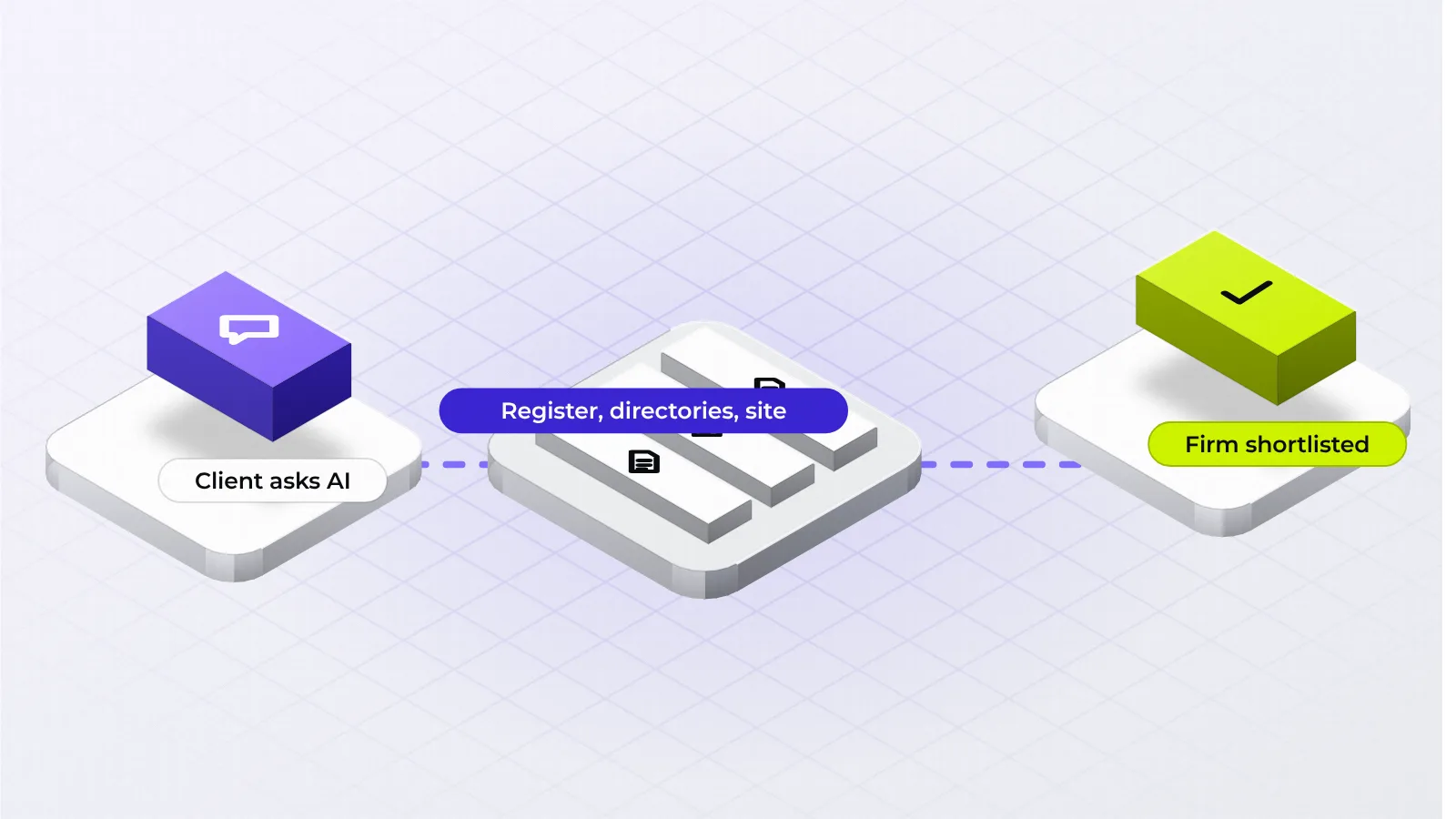
A client who needs a solicitor in Manchester or a corporate lawyer in Dubai now has a step before the search engine and before the phone call. They describe the problem to an assistant, ask who handles it, and read a short list with reasons. The firms on that list get checked. The firms not on it do not. In our 26 October 2026 run, the answers to nine law and professional-services questions were built mostly from the regulator's register, the Law Society directory, Chambers and the assistants' own help pages, and for one UK compliance question the assistants quoted American bar rules instead.
This page is for managing partners, practice heads and marketing leads at mid-size firms in the UK and the UAE. It sets out what the client surveys say, what the questions look like, which sources the answers were built from, where the assistants got the jurisdiction wrong, and the four fixes a firm can make in a quarter without hiring anyone. The general method behind those fixes is in how buyers meet a firm in AI assistants.
What the Surveys Say
Three UK-relevant surveys this year measure the same shift with different rulers. Clio's 2026 Legal Trends Report says 46% of US adults it surveyed would consult AI before contacting a lawyer, and its separate UK and Ireland study found 81% of firms say they disclose AI use while 7% of clients recall it happening, which says something about how much of the firm's own messaging reaches the client. Access Legal's Value Gap 2026 survey of 1,000 UK clients who had used conveyancing, wills, family or personal injury services found personal recommendation still the most common way to choose a firm at 17%, with online reviews and ratings fourth at 14%, and 36% of clients believing AI could replace a solicitor for routine matters. The Law Firm Marketing Club's survey of 642 clients found those under 45 putting more weight on a firm's website and online reviews than on personal recommendation, and 61% expecting live chat on the site.
A fourth figure circulates widely: that 28% of consumers were using ChatGPT to research solicitors by late 2025. It comes from a Legal Futures column written by the founder of a legal marketing agency, so we treat it as a vendor claim rather than a measurement. Put together, the picture is consistent. AI sits upstream of the enquiry for a growing minority, it shapes which firms get checked, and recommendation and reviews still decide which firm gets instructed. That makes the AI step a shortlist problem, not a conversion problem.
What Clients Ask
We keep a locked panel of buyer questions and ask them every Monday on ChatGPT, Claude, Gemini and Perplexity through their APIs with web search on, and on Google AI Overviews through a search-results data provider. Nine of the questions are the ones a UK or UAE firm, or a client of one, would ask about finding and checking a firm through AI. They include how clients use ChatGPT to choose a law firm and how a firm gets recommended, what sources assistants use when recommending UK solicitors or accountancy firms, how a UAE firm makes sure ChatGPT and Gemini describe its practice areas accurately, which agency helps Dubai firms get recommended, and what advertising and compliance rules a firm should check before publishing. In the run of 26 October 2026 those nine questions returned 42 answers, 38 of them with at least one traceable citation, drawn from 263 distinct domains.
Two patterns in the answer text matter more than any count. First, on the open question of how clients use ChatGPT to choose a firm, the assistants described a similar sequence: the client explains the matter in plain words, asks what kind of lawyer handles it, asks for firms, then compares and narrows before contacting anyone. The firm is named after the problem is understood, not before. Second, on the question of which agency is best, the five assistants named five different first choices, and one of them said plainly that most "best agency" lists are written by the agencies themselves. A client asking the same question about law firms gets the same instability. Being on the shortlist once is not being on it next week.
What the Answers Were Built From
The sites cited most often across the 42 answers, counted as citations from the run report, were:
| americanbar.org (American Bar Association) | 13 citations |
|---|---|
| openai.com (OpenAI product pages) | 11 citations |
| sra.org.uk (Solicitors Regulation Authority register) | 8 citations |
| linkedin.com | 7 citations |
| chambers.com (Chambers directory) | 6 citations |
| marketinglawyers.co.uk (legal marketing agency) | 5 citations |
| help.openai.com (OpenAI help pages) | 5 citations |
| solicitors.lawsociety.org.uk (Find a Solicitor) | 5 citations |
| calpartners.co.uk (legal marketing agency) | 3 citations |
| lunasol.ae (Dubai agency) | 3 citations |
| law360.com (legal news) | 3 citations |
Source: ThriveFinity AI Visibility panel v3, weekly run of 26 October 2026, nine law and professional-services prompts on five assistants, each asked once, 2026. Counts are citations, so one answer citing a site twice counts twice. Gemini's links resolve through a Google redirect and could not be traced to a domain, so they are not counted. ThriveFinity was named in none of the 42 answers. Chart by ThriveFinity.
Read by question, the pattern is sharper. The question about which sources assistants use for UK solicitors drew the SRA register seven times, the Law Society's Find a Solicitor five times, Chambers twice and the Law Society's main site twice. The assistants answered the question by doing the thing: they went to the regulator and the directories to find out who exists and what they are allowed to do, and only then to firm sites for the detail. For a client asking for a shortlist, that is the order of trust. A firm whose SRA entry lists an old office, whose Law Society entry omits a practice area, or whose Chambers profile names a partner who left, is being described from the stale version.
The three largest sources outside the legal set were the assistants' own pages. OpenAI's product and help pages were cited 16 times between them, mostly on the questions about how clients use ChatGPT and how a firm checks what AI says about it. The assistants explained themselves with their own documentation, which is fair, and it means a firm that wants to understand the mechanics should read those pages rather than an agency's summary of them.
The Jurisdiction Problem
The most cited site in the whole set was the American Bar Association, with 13 citations, almost all on one question: what advertising and compliance rules a law firm should check before publishing AI visibility or SEO content. The prompt did not say which country. ChatGPT answered explicitly for a US firm, and the citations across the five answers went to the ABA model rules, the New York City Bar and the Florida Bar, with the SRA cited once. The common advice was sound, treat AI content as lawyer advertising, but the rules it pointed to were American. That is a reasonable answer to a question that did not name a jurisdiction, and it is the wrong answer for a firm in Leeds or Dubai.
The lesson for a UK or UAE firm is not that the assistants are careless. It is that a client in those markets who asks a general question gets US framing unless something in the question or in the firm's public pages anchors the answer to the right place. A practice-area page that says "regulated by the Solicitors Regulation Authority, SRA number such and such, offices in Leeds and Manchester" in its first paragraph gives the assistant the anchor. A page that says "a leading full-service firm" gives it nothing.
UAE Firms
Two of the nine questions were set in the UAE. The question about how a UAE law firm makes sure ChatGPT and Gemini describe its practice areas accurately drew Chambers four times and an international firm's own practice pages twice, with no UAE regulator or court register cited at all. The question about which Dubai agency helps firms get recommended drew OpenAI's pages six times and then a set of Dubai agency sites, one of them three times. Where the UK answers had a public register to lean on, the UAE answers leaned on a commercial directory and on whichever firms and agencies had published clear practice pages in English.
For a UAE firm that is both a risk and an opening. The risk is that an international firm with a well-maintained Chambers profile and a practice page per emirate becomes the default description of what a practice area looks like in the UAE. The opening is that the bar for being the cited page is lower than in the UK: a plain English page per practice area and per free zone, naming the courts and regulators it works in front of, is cited because little else is. Every answer in the set also said a firm cannot guarantee what an assistant says about it, only make accurate information easy to find and check. We agree, and we say the same about our own brand on the AI Presence page.
Four Fixes for a Quarter
- Make the register and the directories agree with the website. Check the SRA entry, Find a Solicitor, Chambers and Legal 500 (and for UAE firms, Chambers and the free-zone directories) for practice areas, offices, partner names and the firm's description. Fix the website to match where the website is wrong, and request corrections where the directories are. This is the entity work from the AI Presence audit, applied to the places legal answers actually cited.
- One page per practice area and location, answer first. The first paragraph should answer the plain question a client types ("who handles contested probate in Bristol") with the regulator, the office and the named people, before any description of the firm's values. The compliance question showed that an unanchored page gets an unanchored answer.
- Named people with credentials on every page. The answers that named firms named partners too, and pulled their credentials from Chambers and LinkedIn. A page with a byline, an SRA or bar number, and a link to the person's profile gives the assistant three sources that agree. Add LegalService, Person and FAQPage structured data so the agreement is machine-readable.
- Ask ten real questions a month and keep the answers. Five assistants, ten questions a client would ask, once a month, in a spreadsheet with the cited pages. The point is not the mention count, which will be zero for most mid-size firms for a while. The point is to see which register or directory the answer was built from and whether it was right. Our weekly method is the one the figure above comes from, and the free check below runs a smaller version of it.
Limits of This Page
- Our observations are 42 answers from one week, nine questions on five assistants, each asked once. Mention rates at that size have ranges wide enough that a change of one or two answers means nothing, as the confidence-interval post explains.
- The questions were written from a firm's point of view (how do I get recommended, what should I check) as well as a client's (how do people use ChatGPT to choose a firm). A panel of pure client questions, by practice area and city, would cite more firm sites and fewer agency sites. We have not run that panel.
- The Clio, Access Legal and Law Firm Marketing Club figures are surveys with their own samples and methods, cited through their own pages and through Legal Futures reports checked on 6 November 2026. The 28% figure is a vendor column and is labelled as such.
- Nothing here promises that an assistant will name your firm. It describes where the answers came from on one day. Errors we find are logged on the errata page.
Spotted something out of date or wrong on this page? Email om@thrivefinity.uk and we respond within 5 working days.
❓ Common Questions
Do clients really use ChatGPT to find a solicitor?
Which sources do AI assistants use when they recommend a UK solicitor?
Does this apply to accountancy and consulting firms too?
What can a firm do in a quarter?
Sources
- ThriveFinity. AI Visibility panel v3, weekly run of 26 October 2026, nine law and professional-services prompts (42 answers) and their citations. Method on the methodology page.
- Clio. Legal Trends Report 2026 (the 46% figure is for US adults, per Clio's press release) and UK and Ireland Legal Insights Report 2026 (513 legal professionals, 500 members of the public). Vendor research. Re-fetched 21 November 2026.
- Legal Futures. Half of clients think AI can replace solicitors. 25 March 2026. Report of Access Legal's The Value Gap 2026 survey of 1,000 UK clients. Re-fetched 21 November 2026.
- Legal Futures. Clients uncomfortable about widespread use of AI. 10 April 2026. Report of the Law Firm Marketing Club survey of 642 clients. Re-fetched 21 November 2026.
- Legal Futures. Concerned that AI is affecting enquiries? Here's what to do. John Anderson, Somuna. 23 July 2026. Agency column, source of the 28% figure. Re-fetched 21 November 2026.