

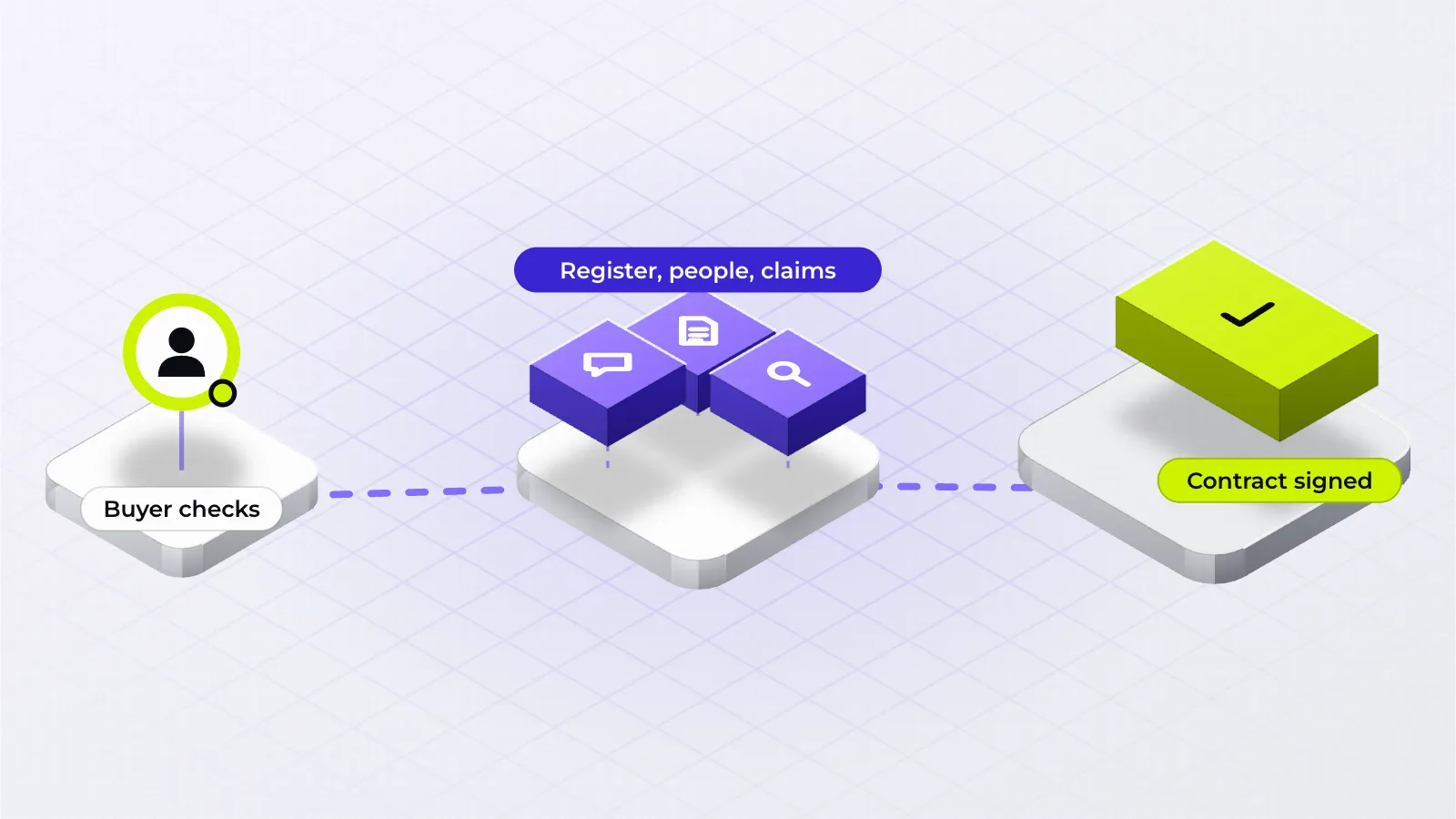
A buyer in London or Austin who likes your proposal will, before signing, try to verify eight things: that your company legally exists at a real address, that the people on the call are real and findable, that your site, LinkedIn page and directory listings describe the same business, that you quote in their currency with their taxes handled, that someone in their market will vouch for you, that you'll be reachable in their working hours, that the contract names a law and a data location they can live with, and that the claims on your site have sources. Fail one and the deal slows. Fail three and it quietly dies.
This page is for founders and heads of growth at Indian and Asian B2B services and software companies selling into the US and UK. I've sold B2B work from Chennai into the UK, the UAE and the US, including two years as a consultant to a UK company, and most of what follows is the list I wish I'd had in year one. Where I cite numbers, they come from our own data or a named government page. Where it's my experience, I say so.
The Eight Signals, in the Order Buyers Check Them
- A verifiable legal entity. Company name, registration number, registered address and the register it sits on, all on your site and matching each other.
- Named people with real profiles. The founder and anyone the buyer will work with, with photos, roles and LinkedIn profiles that say the same thing as the site.
- One consistent description everywhere. Your site, LinkedIn, Google Business Profile, Clutch, G2 and any directory describe the same services for the same buyers. Old positioning on a profile you forgot about counts against you.
- Local pricing and payment. Prices in USD or GBP, tax treatment stated, bank transfer or card in their currency, and an invoice their finance team can process.
- References in or near their market. A named client in the US or UK, or the closest honest substitute.
- Coverage of their working hours. A stated overlap window, a response time you keep, and a named person on their side of the clock.
- Contract law and data location. Which law governs, where disputes go, where data is stored and who the sub-processors are.
- Sourced claims. Every number on your site traceable to a client, a dataset or a dated document.
Why Buyers Check, and What AI Tells Them to Check
Buyers check because they're the ones who carry the risk if the vendor disappears, and because verifying a foreign company is now easy. In the UK, anyone can look up a company's registered address, date of incorporation, current and resigned officers and filed documents for free on the Companies House register, which GOV.UK lists under get information about a company. The same buyer can see your Indian registration on the Ministry of Corporate Affairs portal in a minute. If your site says something the register doesn't, they'll believe the register.
They also ask AI assistants. On 26 October 2026 we ran nine buyer questions about an Indian or Asian B2B company entering the US or UK on five assistants (ChatGPT, Claude, Gemini, Perplexity and Google AI Overviews, web search on, each question once). Forty-one of 45 requests returned an answer and 33 of those cited at least one page. The single most cited site was LinkedIn, in 10 of the 41 answers. The US International Trade Administration's site appeared in 4. The rest were mostly go-to-market agencies and consultants writing about market entry.
| 10 answers | |
| trade.gov (US International Trade Administration) | 4 answers |
| Most cited single agency site | 4 answers |
| Three other agency and consultant sites | 3 each |
| FTC and Gartner | 2 each |
Source: ThriveFinity AI Visibility panel v3, weekly run of 26 October 2026, segment S3 (9 prompts, 5 assistants, 41 answers), 2026. Counts are answers citing the site at least once. Gemini's links were Google redirect addresses and are not counted by site. One run, one day. Chart by ThriveFinity.
One answer is worth quoting because it shows what a buyer is told to do. When ChatGPT answered Who can help an Indian B2B company enter the UK market with positioning, website and sales deck?, it listed ThriveFinity among the options and added, for us as for every other vendor it named, a line of due diligence: Ask for relevant UK-entry client references and clarify the exact website and deck scope before commissioning. That's the buyer's checklist in one sentence, written by the assistant. References in the buyer's market and a defined scope are what it told the reader to verify first. Where each assistant looks for that evidence is in where each AI assistant gets its answers.
The Checklist: What They Check, How to Show It, Where
Copy this table into your own tracker. The last column is the place the buyer will actually look, which is rarely your homepage.
| Signal | What the buyer checks | How to show it | Where they look |
|---|---|---|---|
| Legal entity | Registered name, number, address and officers match the public register | Put the registered name, CIN or company number and address in the footer and on the company page. Use the registrar's spelling, not a nicer one | Companies House, MCA portal, your footer |
| Real people | The founder and team exist, have a history, and say the same thing as the site | Named bios with roles and a LinkedIn link each. Update the LinkedIn headline when the positioning changes | LinkedIn, your About page, a search of the founder's name |
| One description | Site, LinkedIn page, Google Business Profile and directories agree | Keep one canonical one-line description and address, and refresh every profile from it in the same week | LinkedIn, Google, Clutch, G2, F6S, Crunchbase |
| Local pricing | Can finance process this without a conversation? | Prices in USD and GBP, tax wording per country, card and bank transfer in their currency, invoices from the registered entity | Pricing page, proposal, first invoice |
| References | Has anyone like me paid you and would they say so? | A named client in their market with a quoted, approved line. If none yet, a paid pilot with written scope | Case studies, the reference call |
| Working hours | Will I get a reply today? | State the overlap window (for example 9am to 1pm Eastern, or UK afternoon and evening) and a response time, then keep it | Contact page, proposal, the first three emails |
| Law and data | Which law, which courts, where is our data? | Governing-law clause per client base, a sub-processor list, data location and retention stated on a trust page | Terms, privacy policy, trust page, security questionnaire |
| Sourced claims | Is that number real? | Each statistic links to the client, the dataset or the dated document. Samples labelled as samples | Homepage, case studies, deck |
Source: ThriveFinity, from our own experience of selling B2B services from India into the UK, UAE and US, and the public-register facts cited above. A practitioner's list, not a survey.
Two of these are cheaper than they look. Registering the entity you already have on every profile costs a morning. Adding USD and GBP prices with the right tax wording costs a day with your accountant. The expensive ones are references and consistency, because both take months and neither can be bought.
If you decide a UK company is worth having for procurement reasons, GOV.UK says online registration costs £100 and a company is usually registered within 24 hours, with a separate page of rules for the registered office address. See set up a private limited company. A UK entity on its own is not a trust signal. A UK entity with a real address, a real officer and a filing history is.
What Not to Do
The shortcuts are well known to buyers, and each one is now easy to catch.
- A virtual office presented as headquarters. A buyer who searches the address finds forty other companies at it. Say "registered office" if that's what it is, and show your real office too.
- Stock photos or invented names on the team page. A reverse image search takes seconds. Fewer real people beat more fake ones.
- Logos of companies you've never invoiced. A reference call ends it. Use only clients who've agreed to be named.
- A US or UK phone number nobody answers. Worse than none, because it fails the working-hours check at the first call.
- Statistics with no source. "Trusted by 500 companies" with no list is read as zero.
In the UK this isn't only a matter of taste. The Business Protection from Misleading Marketing Regulations 2008 cover advertising to traders, and regulation 3 says all features of an advertisement are considered, including what it says about the advertiser's identity and the product's commercial origin.
deceives or is likely to deceive the traders to whom it is addressed
That's the test for misleading advertising to a business buyer: whether it deceives or is likely to deceive the traders it's addressed to, in a way likely to affect their decision. A false "London office" or a borrowed client logo sits squarely inside it. The practical rule is simpler: say where you are and show what's true. In my experience the UK buyers who hired us knew from the first call that we were in Chennai. What they wanted was proof we'd be there at 6pm their time, and we were.
Where ThriveFinity Fits
If the list above is your to-do list, two of our services do parts of it. AI Presence is the consistency work: one canonical description and address, applied to the profiles buyers and AI assistants actually cite, with the stale ones corrected. The Go-to-Market Build is the rest of the front door: positioning for the buyer's market, a website and sales deck written with sourced claims, pricing in the buyer's currency, and an outbound sequence, delivered to a fixed scope. The PayRam case study shows what that looks like for a company selling from the UAE into several markets. If you only need to know whether buyers in a new market will pay before you build anything, start with the Decision Brief.
Limits of This Page
- The eight signals are a practitioner's list from one firm's experience, checked against public-register facts. They are not from a buyer survey. If you have survey data on what US or UK procurement teams verify, we'd like to see it.
- The AI-answer counts come from one run of nine questions on one day, each asked once per assistant through APIs with web search on, not the consumer apps.
- GOV.UK pages on company information and registration were checked on 30 October 2026 and can change. The £100 fee and 24-hour time are GOV.UK's figures on that date.
- This page describes UK advertising law as a lay reader of the regulation, not as legal advice. Ask a solicitor before relying on it.
- Nothing here covers tax residency, permanent establishment or visa questions, which need an accountant and a lawyer in the target market.
Spotted something out of date or wrong on this page? Email om@thrivefinity.uk and we respond within 5 working days.
❓ Common Questions
Do I need a UK or US company to sell there?
Should I hide that the company is based in India?
What if I have no references in the buyer's market yet?
Sources
- GOV.UK. Get information about a company. Fetched 30 October 2026.
- GOV.UK. Set up a private limited company: register your company. Fetched 30 October 2026.
- legislation.gov.uk. The Business Protection from Misleading Marketing Regulations 2008, regulation 3. Fetched 30 October 2026.
- ThriveFinity. AI Visibility panel v3, weekly run of 26 October 2026, segment S3 (9 prompts, five assistants, 45 requests, 41 answers). Counts recomputed from the run file on 30 October 2026. Method on the methodology page.