

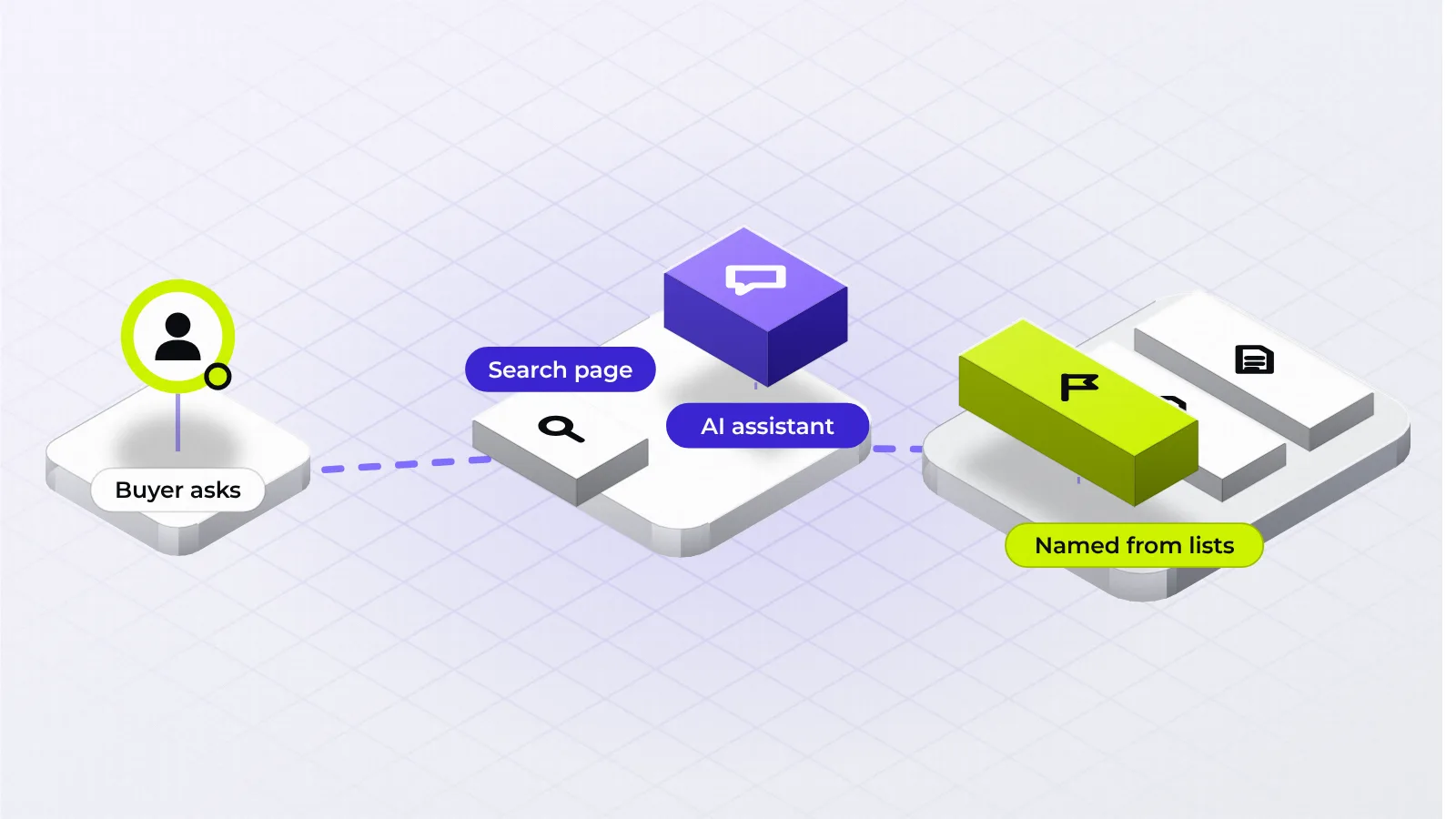
OpenAI said on 2 November 2026 that search-type queries inside ChatGPT now run at roughly one fifth of Google's query volume. The figure comes from Adam Fry, ChatGPT's consumer product lead, at an OpenAI press event, as reported by 9to5Google and The Verge. It counts questions that send ChatGPT to the web, not visits it sends to websites, and OpenAI did not say which Google number it was dividing by. Even read cautiously, it means a meaningful share of research now ends in an answer that names a few companies, and that for a B2B company the question has moved from do we rank to are we on that list, and what does it say about us.
This page is for founders and marketing leads at B2B companies in the UK, US, UAE, EU and Singapore who are deciding whether this channel deserves attention this quarter. It puts the 20% figure next to Google's own numbers from the same week, then uses one week of our own panel, 219 answers to 46 buyer questions, to show what an assistant does with a buyer's question. If the terms are new, start with what generative engine optimisation is.
What the 20% Figure Measures
The claim is specific and narrower than the headlines. ChatGPT handles search-type queries at about a fifth of Google's volume. Three caveats are worth holding onto. First, it is OpenAI's own figure, given at a press event, with no published method. Second, it counts queries, not people, and not traffic sent to anyone's website. Third, the denominator was not disclosed, so nobody outside the two companies can reproduce it. 9to5Google's report also notes that Fry said most people do not seem to mind ads in ChatGPT, which is a signal about where the product is going rather than about search volume.
roughly one-fifth (20%) of the volume of queries of Google.
What the figure does establish is scale. Two years after ChatGPT search launched, the channel is large enough that a B2B company cannot assume its buyers start on a results page. It is a size signal for the channel, not a share of your audience.
What Google Said the Same Week
Google's numbers point the same way from the other side. Alphabet's third-quarter 2026 results, published on 28 October, put Google Search and other revenue up 12% year on year to $63.35 billion and described the year-on-year growth in search queries as the highest in five years. On the earnings call, chief business officer Philipp Schindler said that strong growth in AI Mode queries had weighed on search revenue because of lower monetisation in AI Mode, without saying by how much. On 28 October 2026 Google's Ads and Commerce blog announced that ads in AI Mode are scaling to ten more countries, including India, Singapore, Australia and Canada, with Brazil, Mexico and the United Kingdom planned for the fourth quarter of 2026.
Put the two together and the picture is not one engine replacing another. Both are growing, and both are moving the buyer's first contact from a list of links to a written answer. The answer names a handful of companies and cites a handful of pages. Whether you appear in it is now a measurable thing, which is what the rest of this page is about.
What B2B Buyers Ask an Assistant
We keep a locked panel of 46 buyer questions, written the way a buyer would type them into a chat, with the constraints they mention: company size, country, budget, what they have already tried. Five of them name ThriveFinity. The other 41 name nobody. They cover four buyer groups we track: payments and crypto companies in the UAE, Singapore and the UK, B2B software and developer tools in the US and UK, Indian and Asian B2B firms entering the US or UK, and law and professional services firms in the UK and UAE. Every Monday we ask all 46 on ChatGPT, Claude, Gemini and Perplexity through their APIs with web search on, and on Google AI Overviews through a search-results data provider. The method is on the methodology page, linked in the sources.
The questions fall into a few shapes, and the shape decides what the assistant does with it:
- Problem questions ("how do we get our payments product mentioned when buyers ask AI"). The assistant explains a method and cites guides. It rarely names a vendor.
- Category questions ("which agencies help a Singapore fintech with AI search visibility"). The assistant names three to six companies and cites lists, directories and the companies' own pages.
- Comparison questions ("fixed-price go-to-market build or a fractional CMO for a 40-person UK software firm"). The assistant weighs options and names examples of each.
- Brand questions ("is ThriveFinity legit, what does it cost"). The assistant reads the company's own FAQ, pricing and policy pages, plus whatever else ranks for the name.
Sixteen of our 41 unbranded questions are problem questions. On those, no vendor is normally named, so a company's chance to appear is as a cited source, not as a recommendation. That distinction matters when you read any AI visibility score, including ours.
Who Got Named in Our Run
In the run of 26 October 2026, 219 of 230 requests returned an answer. On the 41 unbranded questions, ThriveFinity was named in 1 answer out of 196. On the five brand questions it was named in all 23. The generic UK questions about go-to-market and claim-checking help named us in 4 of 24 answers. We publish the counts because a score without the counts behind it is not worth much, and because the ranges are wide: with about 45 answers per segment, a rate of 0% has a 95% interval that reaches about 8%.
| Brand questions (name ThriveFinity) | 23 answers |
|---|---|
| Generic UK questions | 4 answers |
| Indian and Asian B2B firms entering the US or UK | 1 answers |
| Payments and crypto (UAE, Singapore, UK) | 0 answers |
| B2B software and developer tools (US, UK) | 0 answers |
| Law and professional services (UK, UAE) | 0 answers |
Source: ThriveFinity AI Visibility panel v3, weekly run of 26 October 2026, 46 prompts on five assistants, each asked once, 2026. Answers returned per group: brand 23, generic 24, payments 44, software 45, India to US or UK 41, law 42. Each rate carries a wide 95% interval at this sample size. One week, one company. Chart by ThriveFinity.
Who was named and cited instead is the useful part. The sites cited most often on each group of questions were, with one exception, not vendor homepages:
| Question group | Sites cited most often (answers citing each) | What they are |
|---|---|---|
| Payments and crypto | icoda.io 13 · linkedin.com 9 · victoriaolsina.com 7 · madx.digital 6 · theasianbanker.com 6 | Two specialist crypto marketing agencies, LinkedIn, a consultant's site, a trade publication. The FCA and a UAE regulator's rulebook were also cited. |
| B2B software and developer tools | developers.google.com 13 · beomniscient.com 6 · help.openai.com 5 · developers.openai.com 5 · derivatex.agency 5 · siftly.ai 5 | Platform documentation first, then a content agency, an AI search agency and a tooling vendor. |
| Indian and Asian firms entering the US or UK | linkedin.com 17 · marketing-interactive.com 11 · consultancy.uk 7 · everything.design 6 · enterprisesg.gov.sg 6 | LinkedIn, trade press, a consultancy directory, a design studio, a Singapore government agency. |
| Law and professional services | americanbar.org 13 · openai.com 11 · sra.org.uk 8 · linkedin.com 7 · chambers.com 6 | Professional bodies and regulators, OpenAI's own pages, LinkedIn, a legal directory. |
| Generic UK questions | digitalagencynetwork.com 6 · thrivefinity.uk 5 · uk.trustpilot.com 4 | An agency directory, our own site, a review site. |
Source: ThriveFinity AI Visibility panel v3, weekly run of 26 October 2026. Counts are answers citing the site at least once. Gemini's links could not be traced and are not in these counts.
Of the companies we track as competitors, three were named at all in the run: one UK agency in three software answers and three generic answers, one in two payments answers, one in a single software answer. The companies that were named on the segment questions were mostly ones we had not been tracking, which is a finding in itself: the competitor set an assistant uses is defined by the question, not by your marketing plan.
What It Suggests
What we observed. One company, one week, 219 answers. On unbranded buyer questions we were named once. The sites cited were platform documentation, regulators and professional bodies, LinkedIn, trade press, directories and specialist agencies' own pages, in that rough order by group.
What it suggests. If the channel is a fifth the size of Google and growing, the work is not the work of ranking. An assistant answering a category question does not judge the vendors. It repeats whoever appears on the pages it already trusts for that question, and those pages are mostly not the vendors' own. A good homepage is necessary and not sufficient. That is a hypothesis from one run on one company, and the counts above are small enough that we would not act on a single week's change in either direction.
What to do next. Treat the next month as a measurement month, not a spending month. The three steps below cost time, not money.
Three Things to Do This Month
- Ask the assistants your buyers' questions, not your keywords. Take ten questions from sales calls and intake forms, written as a buyer would type them, with their constraints. Ask each on ChatGPT, Perplexity and Google AI Overviews. Record who is named and which sites are cited. The walkthrough is in how to run an AI visibility check.
- Read what the answer says about you, and about the company it named instead. Being named is the outcome. What the answer claims about you is the risk. In the same October run an assistant still described two services we retired, because the pages it read had not changed. Fix the stale pages you control first, in the order given in the pages AI assistants cite about your company.
- Make a list of the lists. For each category question, note the two or three third-party pages cited most: the directory, the trade article, the professional body's listing. Those are the pages that decide the answer. Getting onto them honestly, with the same company description everywhere, is the first step of our AI Presence service, and most of it can be done in-house with a spreadsheet.
Then repeat the same questions on the same assistants a week later. Judge the change in counts over several weeks, with the ranges, not in one answer.
Limits of This Page
- The 20% figure is OpenAI's own, reported from a press event on 2 November 2026 with no published method and an undisclosed denominator. We report it as stated and do not adjust it.
- Alphabet's third-quarter figures and Google's AI Mode ads announcement were checked on 6 November 2026 from Google's own blog and from press reports of the earnings call. They can change.
- Our panel is one company's 46 questions, each asked once per assistant in one week. Four assistants were API calls with web search on, not the consumer apps. Google AI Overviews came through a search-results data provider with the UK as the default location.
- A citation shows that an assistant linked a page. It does not show how much of the answer came from that page. Gemini's links could not be traced in this run.
- Rates are reported with the counts behind them because the 95% intervals are wide at this sample size. Errors we find are logged on the errata page.
Spotted something out of date or wrong on this page? Email om@thrivefinity.uk and we respond within 5 working days.
❓ Common Questions
Does 20% of Google's volume mean 20% of my buyers use ChatGPT instead of Google?
Is Google search shrinking?
How do I find out what buyers ask an AI assistant about my category?
Which matters more, being named or being cited?
Sources
- 9to5Google. ChatGPT has hit roughly 20% of Google Search volume, OpenAI says. 3 November 2026, reporting Adam Fry at an OpenAI press event covered by The Verge. Fetched 6 November 2026.
- Google, Ads and Commerce blog. Ads in AI Mode expand to more countries. 28 October 2026. Fetched 6 November 2026.
- Search Engine Journal. Google Says Lower AI Mode Monetization Weighed On Search Growth. Report of Alphabet's Q3 2026 results (28 October 2026) and earnings call. Fetched 6 November 2026.
- Search Engine Roundtable. Google: Ads In AI Mode Earning Less Than Traditional Search Ads. 29 October 2026, with the call transcript excerpt. Fetched 6 November 2026.
- ThriveFinity. AI Visibility panel v3, weekly run of 26 October 2026 (46 prompts, five assistants, 230 requests, 219 answers) and the 18 October 2026 baseline. Method on the methodology page.