

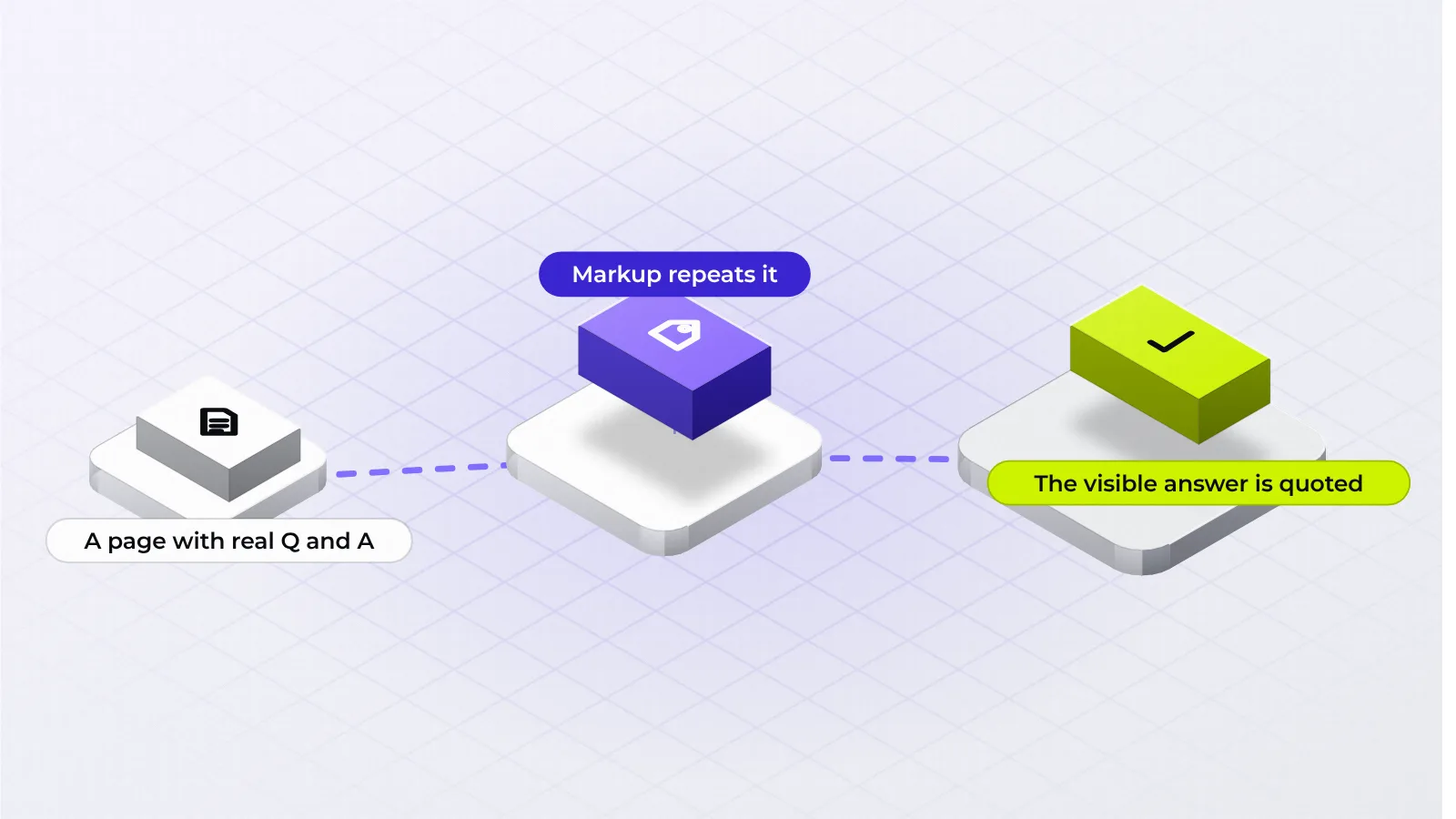
"Add FAQ schema so AI will cite you" is one of the most repeated pieces of advice in AI search. It is cheap to follow, which is part of its appeal. The evidence does not support it: Google removed FAQ rich results for every site in May 2026, says no special schema is needed for AI Overviews or AI Mode, and a controlled study of 1,885 pages found no citation gain from adding it. FAQ schema is harmless and still valid. The visible question-and-answer content is what does the work.
This page is for whoever runs the website at a B2B company. It explains what FAQ schema is, what Google changed and when, what the evidence says about AI citations, what the markup still does, and what to do with the schema you already have. It also says what we do on this site, since every post here carries the markup.
What FAQ Schema Is
FAQ schema is a block of structured data, usually in a format called JSON-LD, that repeats the questions and answers on a page in a form software can read without interpreting the layout. The schema.org type is called FAQPage. It was popular for one reason: for several years Google used it to show an expandable list of questions under a search result, which made the listing bigger.
What Google Changed
| Date | Change |
|---|---|
| August 2023 | Google limits FAQ rich results to well-known government and health sites.4 |
| 7 May 2026 | FAQ rich results stop appearing in Google Search for every site, including government and health.1 |
| May 2026 | Google publishes its guide to generative AI features in Search. Structured data is not required, and there is no special schema.org markup to add.2 |
| June 2026 | The FAQ search appearance, its Search Console report and Rich Results Test support are removed.1 |
| August 2026 | Search Console API support for FAQ rich result data is removed.1 |
Sources 1, 2 and 4. Google gave an exact date only for 7 May.
So the visible reward has gone. FAQPage is still a valid schema.org type, and Google's own guide still recommends structured data in general, for the rich results that remain.2
What the Evidence Says About AI
With the rich result gone, the pitch moved. The markup, the argument now runs, helps AI systems cite you. Three things are worth knowing.
- Google says it is not needed. Its guide to generative AI features in Search says structured data is not required, and that there is no special schema.org markup you need to add.2 The same guide says Google Search does not use llms.txt or other new machine-readable files.
- No AI company we know of has said it helps. We found no statement from OpenAI, Anthropic, Perplexity or Google that FAQPage markup raises the chance of a citation.
- The best controlled test found no gain. Ahrefs tracked 1,885 pages that added JSON-LD between August 2025 and March 2026, against 4,000 matched pages that did not, and compared citations 30 days before and after.3 AI Mode citations rose 2.4% and ChatGPT 2.2%, both small enough to be noise. AI Overviews citations fell 4.6%, a statistically significant but small change, at a time when both groups were already falling.3
The study has one limit worth naming. Every page in it already had more than 100 AI Overview citations before schema was added. It shows that schema did not lift pages AI already reads. It cannot say whether markup helps a page AI has never seen.3
You will also find articles claiming large uplifts, some with precise multiples. We could not trace those figures to a published method, so we are not repeating them. The correlation behind them is real but misleading. In a first pass over 6 million URLs, Ahrefs found AI-cited pages were almost three times as likely to carry JSON-LD as pages that were not cited.3 Sites that maintain their markup tend to maintain their content, links and technical health too, and those are what get pages cited.
What It Still Does
Three modest things.
- It states the page's questions and answers unambiguously. Structured data repeats what the page says in a form software can read without interpreting the layout. That may help a system understand the page. "May help understand" is a long way from "earns a citation", and it is the honest size of the claim.
- It keeps you disciplined. If the markup has to match the visible FAQ, the FAQ has to exist and be kept current.
- It is read by other software. Search engines other than Google, site search tools and some crawlers use structured data. We have no evidence on how much.
What actually gets quoted is the visible text. A real question as a heading, with a direct answer in the sentence beneath, is easy for a person to scan and for an assistant to lift. That is a writing choice. The markup only repeats it.
A quick test for any FAQ on your site. Cover the markup and read only what a visitor sees. Is each question one a buyer has actually asked, in their words? Does the first sentence under it answer the question without a preamble? Does the answer agree with your pricing page and your terms? If yes to all three, the section is doing its job and the markup is a faithful copy of it. If not, no amount of structured data will rescue it, because the text an assistant would quote is the text that falls short.
What to Do With Yours
- Keep it where the FAQ is real. Visible questions, useful answers, markup that matches. Nothing to change.
- Remove it where the FAQ was filler. If questions were written only to feed the markup, delete both. Thin FAQs help nobody.
- Do not add it expecting AI citations. If you add it, add it because the page has real questions and answers.
- Spend the saved time on the answers. Rewrite the first sentence under each question so it answers directly. Check each fact against your pricing, terms and About pages.
- Treat other "AI files" the same way. The same reasoning applies to llms.txt, which we cover in what llms.txt does and does not do.
What We Do on This Site
Most posts on this blog, including this one, carry a visible FAQ and matching FAQPage markup, and our pre-publish check fails if the number of questions in the markup differs from the number on the page. We keep it for the second reason above: it forces the visible FAQ to be real and current.
We do have one data point of our own, and it cuts both ways. When we asked four AI assistants 25 questions about ThriveFinity by name on 26 October 2026, our FAQ page was the page they cited most, in 10 of the 25 answers.5 That page carries FAQPage markup. It is also written as the plain questions a buyer asks about us, each answered in its first sentence. One run cannot tell those two apart, and the Ahrefs result suggests the writing is doing the work. The full run is in the pages AI assistants cite about your company.
Limits of This Page
- We read Google's guide and the Ahrefs study at source. Google's FAQ deprecation note is quoted from reports of it, which agree on the dates.
- One controlled study is thin evidence, and it covered pages already cited by AI. A later study could find an effect for pages that are not.
- Our own data point is one run, one company, 25 answers.
- This page covers FAQ schema only. Other structured data types, such as Organization or Product, do different jobs.
- Errors we find are logged on the errata page.
Spotted something out of date or wrong on this page? Email om@thrivefinity.uk and we respond within 5 working days.
❓ Common Questions
Does FAQ schema still work in 2026?
Does FAQ schema help with AI Overviews or ChatGPT?
Should I remove FAQ schema from my site?
What matters more than schema for AI search?
Sources
- Google Search Central. FAQ (FAQPage) structured data, deprecation note added 7 May 2026. Wording checked against reports of it, 28 November 2026.
- Google Search Central. Optimizing your website for generative AI features on Google Search. Last updated 10 July 2026. Checked 28 November 2026.
- Ahrefs. We Tracked 1,885 Pages Adding Schema. AI Citations Barely Moved. Louise Linehan, with Xibeijia Guan, 11 May 2026. Checked 28 November 2026.
- PPC Land. Google kills FAQ rich results: what SEOs saw coming since 2019. May 2026, covering the 2023 restriction to government and health sites. Checked 28 November 2026.
- ThriveFinity. The Pages AI Assistants Actually Cite About Your Company, run of 26 October 2026 (linked above).