

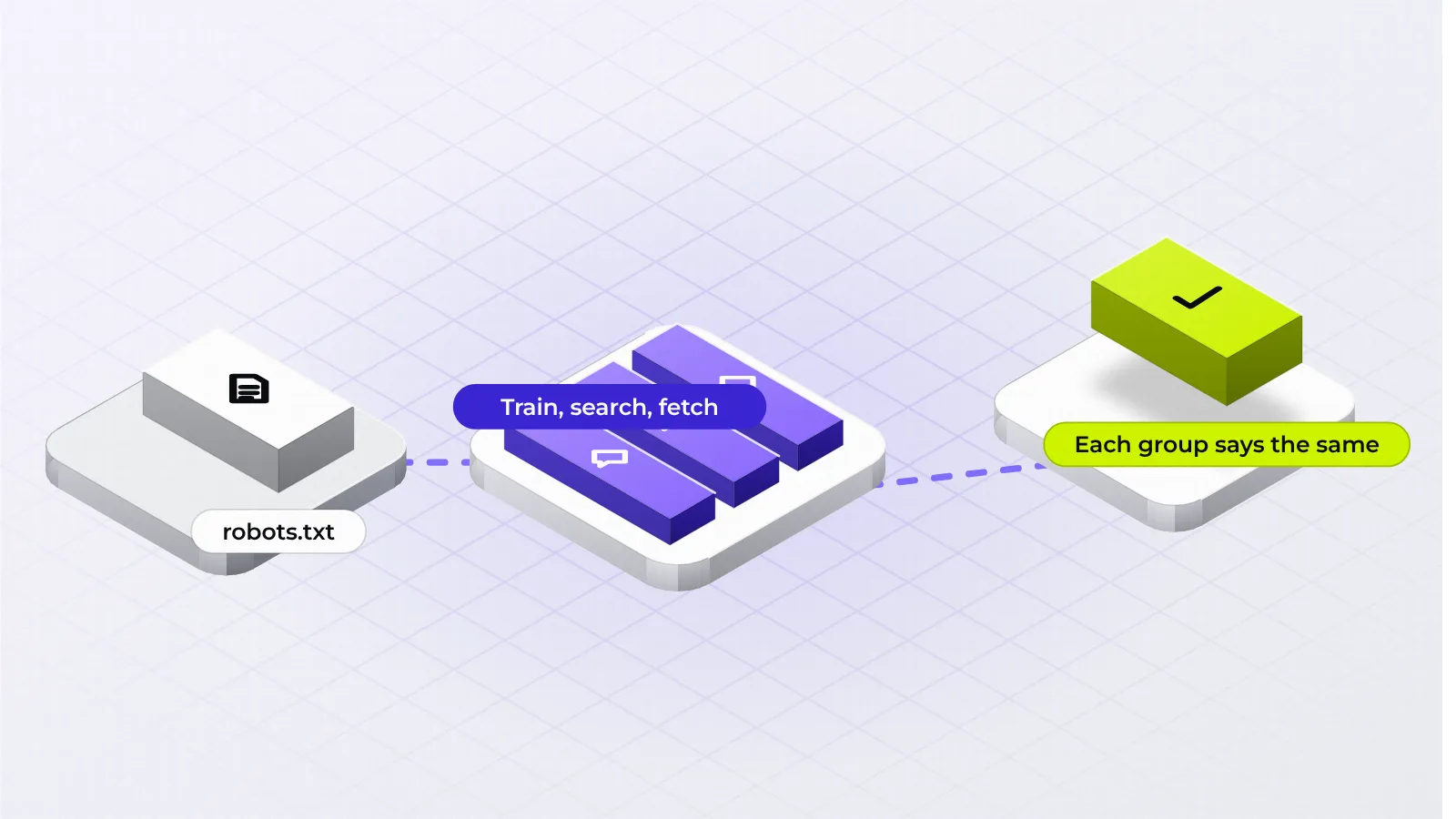
A robots.txt file is a list of requests, read by crawlers that choose to honour it. For ordinary search that was a settled subject. For AI assistants it is not, because each vendor now runs several agents with different jobs, each with its own token, and a rule written for one does nothing for the others. On our own site an October audit found that a disallow we thought applied to every AI crawler applied to none of the named ones, because of a rule in the robots standard that most people have never had to think about.
This page is for the person who owns a B2B site's robots.txt, whether that is a founder, a marketing lead or a developer. It sets out the tokens that matter, what each one controls according to the vendor's own documentation, last checked on 21 November 2026, the group rule, what we found on our file, and a three-step check you can run in ten minutes. Crawler access is one layer of the work in our AI visibility guide.
Three Jobs, Not One Bot
Each of the three vendors whose answers we measure every week runs agents for three separate jobs. One collects pages for model training. One builds a search index that the assistant's search feature draws on. One fetches a page at the moment a person's question needs it. The vendors document these as independent controls. OpenAI's crawler page says each setting is independent of the others and gives the example of allowing its search bot to appear in results while disallowing its training bot. Anthropic's support article lists three bots and states what happens when each is disabled. Perplexity's documentation does the same for its two.
That structure is the whole point. A rule that says "block AI" has to be written three times per vendor, and each of the three lines means something different. Blocking the training bot is a statement about future models. Blocking the search bot removes the site from that assistant's search answers. Blocking the user-triggered fetcher may do nothing at all, because two of the three vendors say those fetches may not follow robots.txt.
The Tokens and What They Control
| Token | Vendor | Job | What the vendor says disallowing it does |
|---|---|---|---|
| GPTBot | OpenAI | Training | Signals that crawled content should not be used to train OpenAI's models. Does not control ChatGPT search. |
| OAI-SearchBot | OpenAI | Search index | Sites opted out are not shown in ChatGPT search answers, though they can still appear as navigational links. Changes take about 24 hours. |
| ChatGPT-User | OpenAI | User-triggered fetch | Not used for automatic crawling. Because a user initiates the request, robots.txt rules may not apply. Not used to decide what appears in search. |
| OAI-AdsBot | OpenAI | Ad landing-page checks | Validates pages submitted as ads on ChatGPT. OpenAI tells advertisers they must allow it. It only matters if you advertise there. |
| ClaudeBot | Anthropic | Training | Signals that the site's future material should be excluded from training datasets. |
| Claude-SearchBot | Anthropic | Search index | Prevents indexing for search, which may reduce the site's visibility and accuracy in search results. |
| Claude-User | Anthropic | User-triggered fetch | Prevents retrieval in response to a user query, which may reduce visibility for user-directed search. |
| PerplexityBot | Perplexity | Search index | Recommended to allow for appearing in results. Perplexity says it is not used for training. |
| Perplexity-User | Perplexity | User-triggered fetch | Generally ignores robots.txt because the request is user-initiated. |
| Google-Extended | Training and grounding control | A token, not a crawler. Governs whether content Google already crawled may be used for Gemini training and grounding. Google says it does not affect Search inclusion or ranking. |
Source: each vendor's own crawler documentation, listed under Sources. All rows checked 21 November 2026. Wording paraphrased. Googlebot, Bingbot and Applebot are left out because they are ordinary search crawlers whose rules have not changed.
Two details in that table do most of the work. First, the search-index tokens are the ones that decide whether an assistant's search feature can show you. A site that blocks OAI-SearchBot and wonders why it never appears in ChatGPT search has answered its own question. Second, the user-triggered fetchers sit outside robots.txt by the vendors' own account. If a person pastes your URL into ChatGPT or asks Perplexity a question whose answer is on your page, the page may be fetched whatever the file says. That is not a loophole, it is the same logic that lets a browser load a page a crawler is asked not to. It does mean that robots.txt is the wrong tool for keeping a public page out of an individual's AI session. It is also a different question from whether an assistant reads your llms.txt, which no vendor documents as a control at all.
The Group Rule
A robots.txt file is a set of groups. Each group starts with one or more User-agent lines and holds the rules that follow. Google's documentation of how it interprets the standard says that only one group is valid for a particular crawler: the crawler finds the group with the most specific user agent that matches it and ignores the others. The default group, User-agent: *, is the group for crawlers that have no more specific match. The same rule is in the Robots Exclusion Protocol as published in RFC 9309, and the AI vendors say their crawlers honour it.
The consequence is easy to miss. If the default group disallows /internal/ and a named GPTBot group below it disallows only /api/, then for GPTBot /internal/ is allowed. The groups are not added together. The named group replaces the default group for that crawler. Every rule the site wants a named crawler to keep has to be repeated inside that crawler's own group.
What Our Audit Found
On 18 October 2026 we checked our live robots.txt against each named crawler. The default group disallowed /internal/, /api/ and /checkout. Twelve named groups, for GPTBot, ChatGPT-User, OAI-SearchBot, ClaudeBot, PerplexityBot, Bingbot, Google-Extended, Googlebot and four others, disallowed only /api/ and /checkout. So the /internal/ rule did not apply to any crawler we had bothered to name, which is to say any crawler we cared about. The audit did not test whether those pages are protected by other means, and robots rules are a request rather than access control, so we treat the file as a statement of intent. Even as a statement of intent, it did not say what we thought it said.
The audit also found that four newer tokens, Claude-SearchBot, Claude-User, Perplexity-User and YandexBot, were not named and therefore fell into the default group. That worked, because the default group allowed them, but it meant their access depended on a group we might one day tighten for some other reason. The fix was mechanical: add Disallow: /internal/ to every named group, and add explicit groups for the four tokens with the same rules as the rest. The live file now has 20 named groups, each carrying the same three disallows. Two older Anthropic tokens, Claude-Web and anthropic-ai, are still named. Anthropic's current article lists only the three bots in the table, so those two groups are inert, and we leave them because they cost nothing.
One decision in that file is commercial rather than technical. We allow GPTBot, ClaudeBot and Google-Extended, which means we accept training use. We also unblocked Common Crawl's CCBot on 18 October, because datasets built from Common Crawl feed some models' background knowledge. The reasoning is that a small company's problem is being described wrongly or not at all, not being quoted too much. Two tokens are blocked outright, cohere-ai and Diffbot, because neither runs an assistant that a buyer of ours would ask. Those are our choices for our situation and the next section is about making yours.
What to Allow
Sort the tokens by job and decide per job.
- Search-index tokens: allow them unless you have a reason not to. OAI-SearchBot, Claude-SearchBot and PerplexityBot are the route into each assistant's search answers, and ordinary Googlebot is the route into AI Overviews and AI Mode. Blocking any of them is a decision to be absent from that surface, and the surfaces differ in how they fetch, as the engine-by-engine breakdown shows.
- User-triggered fetchers: name them and allow them, and do not rely on the file to stop them. ChatGPT-User, Claude-User and Perplexity-User fetch when a person asks. Allowing them explicitly records the intent. If a page must not be fetched by anyone, it needs authentication, not a robots rule.
- Training tokens: a choice about future models. GPTBot, ClaudeBot and Google-Extended govern training (and for Google, grounding in Gemini). A company whose content is its product may block them and lose nothing in search. A company that wants assistants to know what it does may allow them. Cloudflare's August 2025 data gives the scale: GPTBot's share of its crawler traffic rose from 4.7% in July 2024 to 11.7% in July 2025, and ClaudeBot's from 6% to nearly 10%, so the crawl cost is real and the referral return from training crawls is close to nil.
- Whatever you decide, write it in every group. The group rule means a disallow in the default group protects nothing from a crawler you have named.
A Three-Step Check
- Read the file as the crawler does. For each named token, read only its group. List what that group disallows. Compare with the default group. Any rule present in the default group and missing from a named group is a gap, whether or not it matters today.
- Fetch a page as each token. A command-line request with the user agent set to GPTBot, OAI-SearchBot, ClaudeBot, Claude-SearchBot and PerplexityBot against a public page should return 200. A 403 or 429 for one of them means a firewall or CDN rule is overriding the file, which is the commonest reason an allowed crawler never arrives.
- Check the vendor pages, not a summary of them. The tokens and their meanings have changed within the past year (Anthropic added Claude-SearchBot and Claude-User, OpenAI separated OAI-SearchBot from GPTBot) and will change again. The five vendor pages under Sources are the authority. Re-read them when you touch the file.
Limits of This Page
- The token meanings are taken from vendor documentation checked on 6 November 2026 and paraphrased. The vendors can change them without notice. Re-check before relying on any line here.
- Our own findings are one site's file on one date. The group rule is general, but what to allow depends on what the site sells.
- robots.txt is honoured voluntarily. Vendors who say they honour it may still have bugs, and agents that spoof a vendor's token do not read the file at all. Verification against published IP ranges, where a vendor publishes them, is the stronger check.
- Nothing here promises that an assistant will name you. It is about not being absent for an avoidable reason. Errors we find are logged on the errata page.
Spotted something out of date or wrong on this page? Email om@thrivefinity.uk and we respond within 5 working days.
❓ Common Questions
If I block GPTBot, will I disappear from ChatGPT answers?
Does Google-Extended stop Google crawling my site?
Why did our /internal/ rule not apply to the AI bots?
Should I block the training bots?
Sources
- OpenAI. Overview of OpenAI Crawlers, and the OpenAI Help Center article Advertiser Guidance for Allowing OpenAI Web Crawlers. Checked 21 November 2026.
- Anthropic. Does Anthropic crawl data from the web, and how can site owners block the crawler? Checked 6 November 2026.
- Perplexity. Perplexity Crawlers. Checked 21 November 2026.
- Google Search Central. Overview of Google crawlers and fetchers (last updated 12 June 2026), the list of Google's common crawlers (the Google-Extended entry) and How Google interprets the robots.txt specification. Checked 21 November 2026.
- Cloudflare. The crawl-to-click gap: Cloudflare data on AI bots, training, and referrals. August 2025. Checked 6 November 2026.
- ThriveFinity. AI crawler access audit, 18 October 2026, and the live robots.txt.