

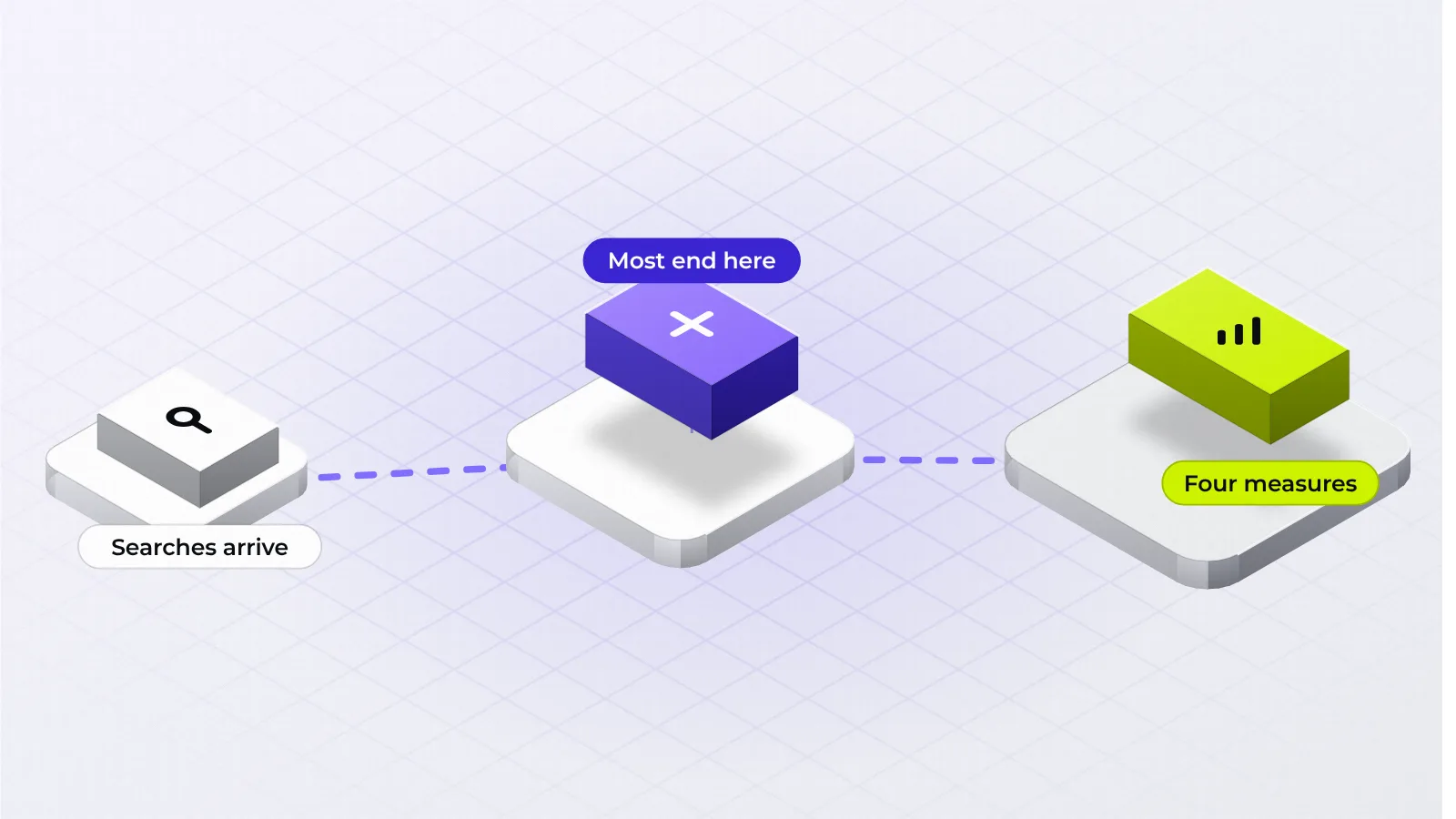
Your rankings have not moved and your visits are down. That pattern has a name. A zero-click search is one that ends on the results page, with no visit to any website. SparkToro put the US figure at 68% of Google searches in early 2026. For a B2B company the response is not to chase the lost clicks. It is to measure four things traffic cannot show: whether you appear in AI answers, whether you are named, whether more people search for you by name, and what enquiries say brought them.
This page is for marketing leads and founders who report on search. It explains the term, sets out what the 2026 studies found and where they are weak, and gives a short set of measures to put next to traffic in a monthly report.
What a Zero-Click Search Is
A searcher types a question, reads what Google shows, and leaves, searches again, or stops. No website receives a visit. The answer may have come from a featured snippet, a map, a knowledge panel or an AI Overview.
Definitions vary, which is why figures do. SparkToro counts a click on an organic result, an advert or one of Google's own properties, such as Maps or YouTube, as a click. A second search in the main search box does not count.1 So its zero-click share covers only searches where nothing at all was clicked.
What the 2026 Figures Say
SparkToro's June 2026 study used Similarweb's desktop and mobile web panel for January to April 2026. It found that 68.01% of US Google searches ended without a click, against 60.45% in its 2024 study.1 Search Engine Land's report on the study adds that the share of searches producing at least one click fell by 9.51 percentage points over the two years.2
A follow-up post gave figures for five more countries.
| Country | Google searches ending without a click |
|---|---|
| United Kingdom | 69.5% |
| United States | 68.0% |
| France | 65.3% |
| Canada | 63.8% |
| Italy | 63.4% |
| Germany | 62.1% |
Source 3. SparkToro, Similarweb panel, 2026. Web browsers only.
Three cautions before you put that in a board deck.
- The panels changed. The 2024 study used a different data provider. SparkToro itself says the comparison is imperfect because the users and devices differ.1
- The Google mobile app is left out. Only searches in a web browser are measured. SparkToro expects the app's zero-click share to be higher.1,3
- The cause is not isolated. SparkToro names AI Overviews as a likely contributor. The study does not measure how much of the rise they account for.2
What AI Answers Add
The clearest evidence on AI answers and clicks is older and smaller. Pew Research Center tracked the browsing of 900 US adults in March 2025. When a results page carried an AI summary, people clicked a search result in 8% of visits. Without one, 15%. They clicked a source cited inside the summary in 1% of visits.4
Two things follow. An AI answer roughly halved the chance of a click in that sample. And being cited inside the answer sent almost nobody through. Citation is visibility, not traffic.
AI Mode, Google's conversational search, is still a small part of this. SparkToro found that 0.34% of searches moved into it in early 2026.1 Google now shows adverts inside it by default, which we covered in our note on AI Mode ads.
Why B2B Is a Different Case
Most zero-click commentary is written for publishers, whose income depends on the visit. A B2B company's does not. Three differences matter.
- The sale does not happen on the first click. A buyer who reads your name in an answer, then hears it again from a colleague, then searches for you directly has been influenced three times. Analytics records one visit, as branded or direct.
- The questions that lose clicks are early ones. "What is" and "how does" questions are the ones a results page can answer. Pew found that longer, question-style searches were more likely to produce an AI summary.4 Comparison and pricing questions still send people to a page.
- Small numbers decide. If twelve companies could buy from you this year, being named when one of them asks matters more than a thousand visits from people who never will.
None of this makes a falling traffic line good news. It means traffic has become a partial measure, and a report built only on it will mislead in both directions.
What Our Own Search Console Shows
Our own figures are a useful warning about reading too much into a low click count. In the 28 days to 21 November 2026, thrivefinity.uk had about 7,100 impressions in Google Search and 3 clicks. The blog had 1,268 impressions and 1 click.6
That looks like zero-click search in action. It mostly is not. The queries that brought the most impressions to the blog sat at average positions between about 20 and 77: "go to market strategy" at 59.7, "positioning statement template" at 20.2, "market validation" at 76.5.6 A page in position 60 is on page six. Few people scroll that far whether or not an AI answer sits at the top.
So check position before you blame the results page. If your pages rank in the top five and clicks still fall, zero-click behaviour is a fair explanation. If they rank on page three and below, the problem is ranking, and the four measures below will not fix it.
Four Measures to Report
Keep traffic and enquiries in the report. Add these beside them.
| Measure | Where to get it | What it tells you | How often |
|---|---|---|---|
| Impressions in AI answers | Search Console, Generative AI performance report | Whether your pages are shown in AI Overviews and AI Mode at all (impressions only, no queries) | Monthly |
| Mentions across a fixed question set | A manual log, or a tracker | Whether you are named, and who else is | Monthly |
| Branded search volume | Search Console, queries containing your name | Whether more people come looking for you by name | Quarterly |
| "How did you hear about us?" | A free-text field on your enquiry form | What analytics cannot attribute | Every enquiry |
Our framework. Source 5 for the Search Console report.
The first two tell you about visibility. Google's Generative AI performance report sits under the main Performance report in Search Console. It counts impressions in AI Overviews and AI Mode by page, country, device and date, but it gives no queries and no clicks.5 For the second, our guide to running an AI visibility check sets out a fixed question set you can repeat each month. Report mentions as counts across the same questions each month. A percentage drawn from ten questions looks more exact than it is.
The third tells you about demand. If you are being named in answers, more people should come looking for you by name over time. Branded search is slow to move and noisy month to month, so read it by quarter.
The fourth is the cheapest and the most often skipped. Add one open question to your enquiry form and read every answer. "ChatGPT suggested you" and "saw you mentioned in a comparison" are things no dashboard will report. Ask it on sales calls as well, and write the answers down in the same place.
One rule for all four: fix the method before you look at the numbers, and do not change it for a year. A measure that is redefined each quarter cannot show a trend.
Limits of This Page
- The headline figures come from one firm using one data panel. They exclude the Google mobile app and are not directly comparable with earlier years.
- The Pew study covers 900 US adults in March 2025. AI answers appear more widely now, so its percentages are a guide to direction, not current rates.
- Neither study separates B2B searches. The section on B2B is our reasoning, not a finding.
- Our own Search Console figures are one small site over 28 days, read from the browser rather than exported.
- The four measures are our framework. We have not tested them against revenue outcomes.
- Errors we find are logged on the errata page.
Spotted something out of date or wrong on this page? Email om@thrivefinity.uk and we respond within 5 working days.
❓ Common Questions
What is a zero-click search?
How many Google searches are zero-click?
Does zero-click search mean SEO no longer matters?
What should a B2B company measure instead of traffic?
Sources
- SparkToro. In 2026, Less than One Third of Google Searches Still Send a Click. Rand Fishkin, 8 June 2026. Checked 28 November 2026.
- Search Engine Land. Google zero-click searches hit 68% in early 2026: Study. June 2026. Checked 18 November 2026.
- SparkToro. Zero-Click Searches: Highest in the UK, Lowest in Germany, and France Has the Most Efficient Searchers. Rand Fishkin, 16 June 2026. Checked 28 November 2026.
- Pew Research Center. Google users are less likely to click on links when an AI summary appears in the results. 22 July 2025. Checked 28 November 2026.
- Google Search Console Help. Generative AI performance report (Search). Checked 28 November 2026.
- ThriveFinity. Google Search Console, property thrivefinity.uk, Performance report, last 28 days, read 21 November 2026.