

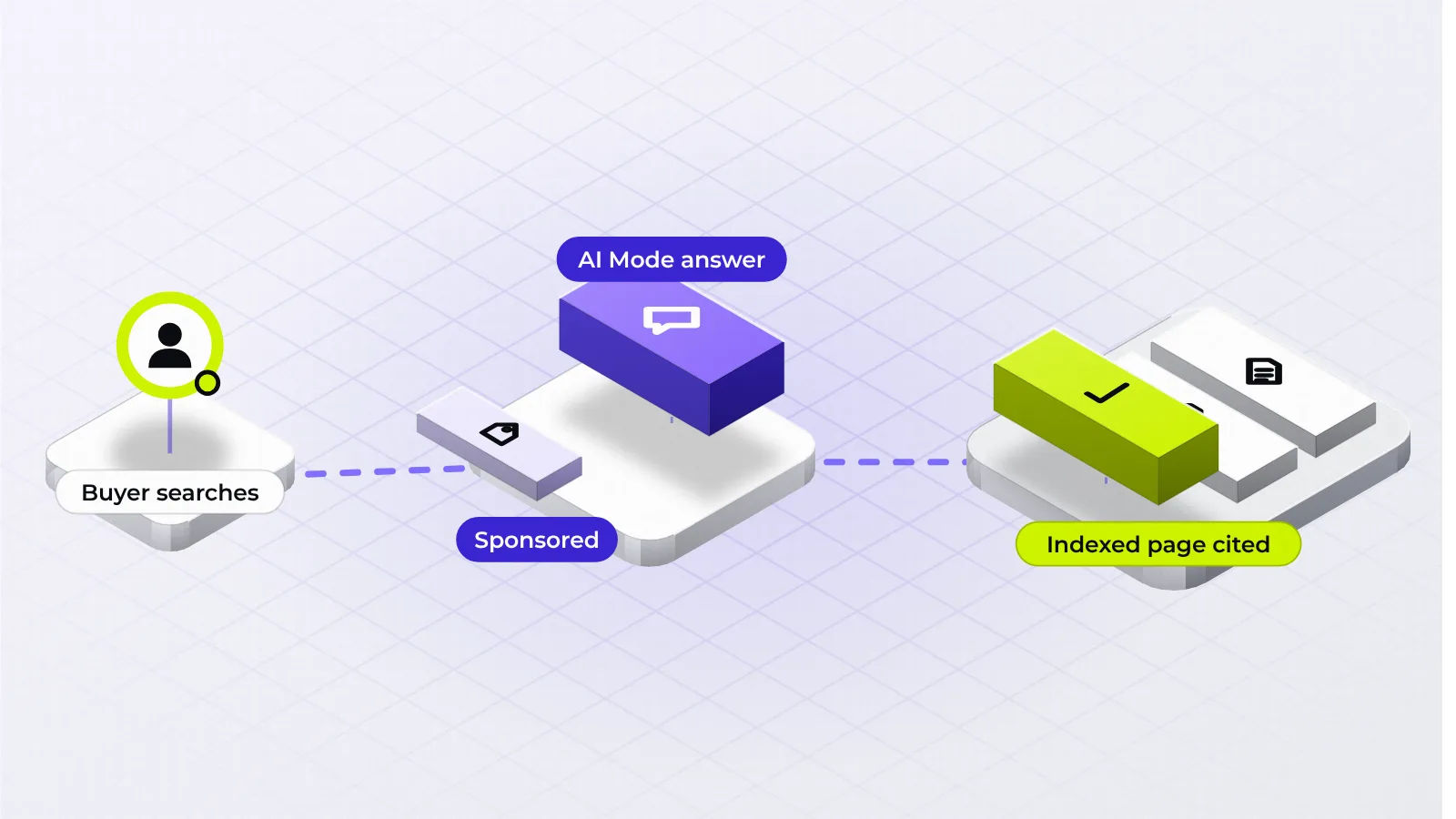
Google is scaling ads inside AI Mode to ten more countries, with the United Kingdom, Brazil and Mexico planned for the fourth quarter of 2026, and existing Search, Shopping and Performance Max campaigns are eligible for those placements by default. The organic part has not changed: Google's own documentation says a page appears as a supporting link in AI Overviews or AI Mode when it is indexed and eligible to show with a snippet, and that no special file, markup or optimisation is needed. So for a B2B company the practical change is this: a buyer's AI answer about your category may now carry a competitor's ad beside it, while the citations inside the answer are still earned.
This page is for marketing leads at B2B companies in the UK, US, UAE, EU and Singapore who run Google Ads, or who depend on Google for buyers, and want to know what the announcement changes before the UK rollout lands. It is an explainer with one set of our own observations. We do not advise on ad spend.
What Google Announced
On 28 October 2026, the day of Alphabet's third-quarter results, Google's Ads and Commerce blog said ads in AI Mode are scaling to Australia, Canada, India, Kenya, Malaysia, New Zealand, Nigeria, Pakistan, the Philippines and Singapore, and that in the fourth quarter of 2026 it plans to expand to additional locales, naming Brazil, Mexico and the United Kingdom. Ads are labelled Sponsored. Search Engine Journal's report of the same day adds two details that matter for advertisers: existing Search, Shopping and Performance Max campaigns are eligible by default with no separate opt-out, and United States users will see ads on follow-up questions inside an AI Mode conversation.
In Q4 2026, we plan to expand to additional locales
Three of the ten new markets are ones we work in: India, Singapore and, from the fourth quarter, the United Kingdom. If you advertise in any of them, the change has already happened to your campaigns, whether or not you changed a setting.
Why Now
The same results gave the reason. Google Search and other revenue grew 12% year on year to $63.35 billion in the third quarter, and Alphabet described the year-on-year growth in search queries as the highest in five years. On the earnings call, chief business officer Philipp Schindler said the strong growth in AI Mode queries had weighed on search revenue because of lower monetisation in AI Mode, and that Google was now scaling ads in AI Overviews and AI Mode to more users and queries. He did not say how much lower, or what the comparison was.
Read plainly: more of the questions Google answers are now answered in AI Mode, those answers earn less per query, and the response is more ads in more countries. The query growth is the part a B2B company should notice. The buyer is still there. The format of the answer has changed. How often that format appears on a commercial question is measured by vendors rather than by Google. One such vendor, Peec AI, reported from a sample of 500,000 business-intent prompts checked in April 2026 that an AI Overview appeared on 86.7% of them, up from 56.9% a year earlier. That is a vendor's figure with a stated sample and an unstated selection method, so treat it as an indication of direction, not a precise rate.
What Still Earns an Organic Citation
Google's documentation on AI features is short and worth reading in full. For a page to appear as a supporting link in AI Overviews or AI Mode, it must be indexed and eligible to be shown in Search with a snippet, meeting the standard technical requirements. There are no additional technical requirements, no new machine-readable files, no AI text files, no special schema. Standard practice still applies: allow crawling in robots.txt, link to the page internally, keep the important content in text rather than in images, and make structured data match the visible page.
Google's May 2026 guide to optimising for its generative AI features says the same from the other direction. It lists tactics site owners can ignore for Google Search: llms.txt and other special files, content chunking, rewriting content for AI, special schema. The guide covers Google's own features only. It says nothing about ChatGPT, Claude or Perplexity, which have their own crawlers and their own sources, as our engine-by-engine comparison shows.
If you want to limit what Google's AI features take from a page, the controls are the ones that already existed: nosnippet, data-nosnippet, max-snippet and noindex for Search, and the Google-Extended robots token to limit training and grounding in Google's other products. We leave both open on our own site, and we will publish the reasoning in a robots.txt post later this month.
What We Saw AI Overviews Cite
What we observed. In our weekly run of 26 October 2026 we asked 46 buyer questions on Google AI Overviews through a search-results data provider, with the UK as the default location and separate runs located in the US, UAE and Singapore for the segment questions. Across the five assistants in that run, Google AI Overviews was the one that leaned most on LinkedIn, YouTube and Reddit, and the location changed the agencies it cited: the US, UAE and Singapore runs favoured agencies in that country. Three of the 40 AI Overviews requests returned a provider error and are left out. The counts by source type are in the engine comparison linked above, so they are not repeated here.
What it suggests. AI Overviews behaves like a search feature that summarises what already ranks for the question in that location, which is consistent with what Google says about how it works. A B2B company that does not rank for a buyer question in a market is unlikely to be cited in that market's AI Overview for it, and an ad beside the answer does not change the citation. That is one week on one company, so it is an observation and not a rule.
What to do next. Treat AI Mode and AI Overviews as a reporting question first. The checks below take an afternoon.
Five Things to Check This Week
- If you run Google Ads in India, Singapore, Australia, Canada or the other six markets, look for AI Mode placements in your reports now. Eligibility is by default. Decide deliberately whether the placements fit your campaign goals rather than finding out from the invoice.
- Ask the buyer questions that matter to you in Google with AI Mode on, in each market you sell to. Note whether an AI answer appears, who it names, which pages it links, and whether a competitor's Sponsored result sits beside it. Set the location to the market, not to where you are sitting. The walkthrough is in how to run an AI visibility check.
- Check the pages you would want cited are indexed and eligible for a snippet. URL Inspection in Search Console shows both. A page blocked by
noindexor anosnippetrule cannot be a supporting link, whatever its quality. - Read what the AI answer says about you, not only whether it names you. A wrong price, a retired service or an old address in the answer is worse than absence. The pages that feed brand answers are listed in the pages AI assistants cite about your company.
- Keep the same measurement every week. One AI Overview is one draw. Judge presence by counts over several weeks, with the ranges, the way we report our own AI Visibility results.
Limits of This Page
- Google's announcement and documentation were fetched on 6 November 2026. The UK timing is "Q4 2026" with no date, and the eligibility-by-default detail comes from Search Engine Journal's report rather than from Google's blog post, which does not state it.
- Alphabet's results were checked through press reports of the 28 October 2026 release and call. The company gave no figure for how much lower AI Mode monetisation is.
- The 86.7% AI Overviews figure is a vendor's (Peec AI) with a stated sample and no stated selection method. It is reported, not verified by us.
- Our observations are one company's 46 questions in one week through a data provider, not the consumer interface. Google AI Overviews and AI Mode are related but not identical features, and our panel measures AI Overviews.
- Nothing here is advice on whether to buy ads. Errors we find are logged on the errata page.
Spotted something out of date or wrong on this page? Email om@thrivefinity.uk and we respond within 5 working days.
❓ Common Questions
Do I need to opt in for my Google Ads to appear in AI Mode?
When do AI Mode ads reach the UK?
Can I pay to appear as a source in an AI Overview or AI Mode answer?
Should a B2B company buy ads in AI Mode?
Sources
- Google, Ads and Commerce blog. Ads in AI Mode expand to more countries. 28 October 2026. Fetched 6 November 2026.
- Search Engine Journal. Google Says Lower AI Mode Monetization Weighed On Search Growth. 28 October 2026. Fetched 6 November 2026.
- Search Engine Roundtable. Google: Ads In AI Mode Earning Less Than Traditional Search Ads. 29 October 2026, with the call excerpt. Fetched 6 November 2026.
- Google Search Central. AI features and your website. Fetched 6 November 2026.
- Search Engine Journal. Google's New AI Search Guide Calls AEO And GEO 'Still SEO'. May 2026, reporting Google's guide to optimising for generative AI features. Checked 6 November 2026.
- Peec AI. GEO statistics for 2026. Vendor page, 500,000 business-intent prompts checked 13 to 20 April 2026. Fetched 6 November 2026. Reported, not verified.
- ThriveFinity. AI Visibility panel v3, weekly run of 26 October 2026, Google AI Overviews surface (UK default, US, UAE and Singapore runs). Method on the methodology page.