

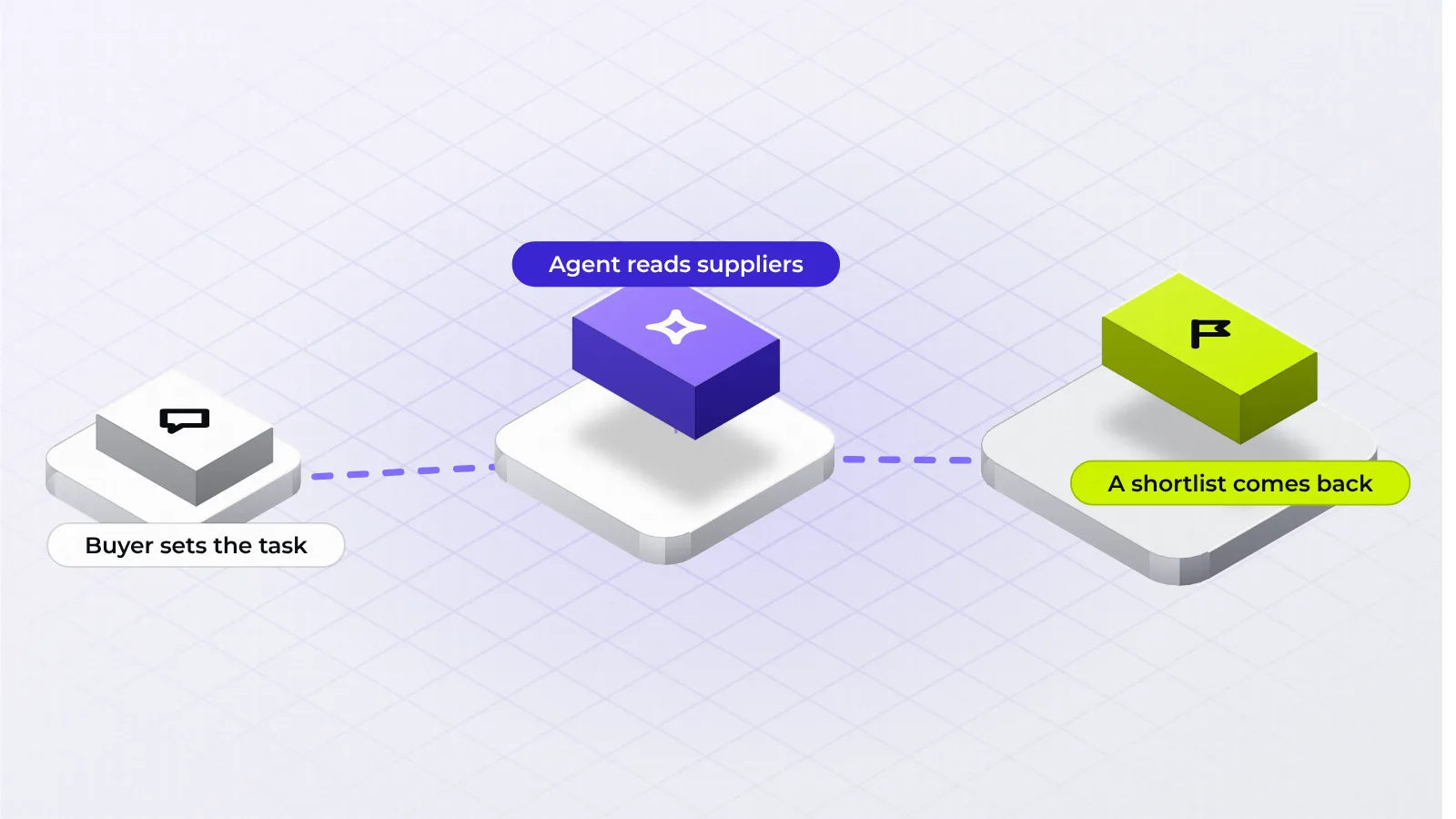
For twenty years the buyer has been a person with a browser. Some of the early buying work can now be done by software acting for that person. Agentic commerce means an AI agent carrying out parts of a purchase on someone's behalf: finding options, comparing them and, in some consumer cases, paying. For B2B sellers the effect arrives first at the research and comparison stage, long before any agent signs a contract.
This page is for founders and marketing leads at B2B companies. It defines the term, sets out the three protocols you will see named, reports what has and has not happened so far, explains why B2B is affected differently from retail, and lists five things worth doing now. The field moves quickly. Every dated fact here was checked against the company's own announcement or a report quoting it on 28 November 2026.
What Agentic Commerce Is
OpenAI introduced the idea to most people on 29 September 2025, when it announced a way to buy inside ChatGPT and described the Agentic Commerce Protocol, built with Stripe, as an open standard that lets AI agents, people and businesses work together to complete purchases.1 In its description, when someone places an order ChatGPT sends the necessary details to the merchant's own systems, and the seller keeps its payments and its customer relationship.1
That is the consumer picture: a person asks, an agent finds and, with permission, buys. One B2B write-up draws a useful line through it. An agent choosing an order is one step. An agent paying without a human entering details is another. The infrastructure to cross from the first to the second is what most B2B sellers do not yet have.6
The Three Protocols
| Protocol | Backed by | What it covers | Date |
|---|---|---|---|
| Agentic Commerce Protocol (ACP)1 | OpenAI and Stripe | Product data and checkout between an AI agent and a merchant | Announced 29 September 2025 |
| Universal Commerce Protocol (UCP)2 | Google, co-developed with Shopify, Etsy, Wayfair, Target and Walmart | Discovery, cart, checkout and order management | Announced 11 January 2026 |
| Agent Payments Protocol (AP2)3 | Google, now with the FIDO Alliance | Signed proof of what a person authorised an agent to pay for | Introduced September 2025. Donated, with version 0.2, on 28 April 2026 |
Sources 1 to 3, each the backer's own announcement. Card networks have their own agent programmes, which are not listed.
Read them as layers more than rivals. Google says UCP works alongside AP2, and ACP and UCP both cover the step from a basket to a checkout.2 AP2 sits underneath, recording what the person agreed to. Since April it is being developed in a FIDO Alliance working group chaired by Mastercard and Visa, which suggests the payment layer will be shared across vendors.3 You do not need to choose between them today. You need to know they exist, because platforms and larger customers will start asking which you support.
What Has Happened So Far
Less than the announcements suggested, and the direction is still clear. In March 2026 OpenAI stepped back from Instant Checkout, its way of buying inside the ChatGPT conversation. Its spokesperson told Digital Commerce 360 that the company was prioritising search and product discovery, with ACP as the infrastructure that connects users to merchants.4 By 24 March OpenAI had said merchants would use their own checkout, with ChatGPT as the place people find them.5
Google went the other way on paper. UCP was launched to power a checkout button on eligible product listings in AI Mode and the Gemini app, with the retailer staying the merchant of record.2 That is consumer retail, and it is early.
We read OpenAI's change as a correction and a signal. Checkout inside a chat window proved harder than expected. Discovery inside a chat window did not. The part of buying that agents already do well is the part that decides who gets considered.
Why B2B Is Different
A retail purchase is one person, one basket, one payment. A B2B purchase usually has a contract, several approvers and negotiated terms. One analysis notes that in B2B the agent tends to work inside an existing agreement and not across an open marketplace.6 Reordering from an approved supplier is the natural first use. Choosing a new consultancy is not.
That does not leave B2B untouched. The stages before the contract are research and comparison, and those are the stages assistants already handle. A buyer who asks an assistant to "find three firms that do this for companies our size, with prices" has delegated the shortlist. Whether you appear on it depends on what the assistant can read about you. How buyers already build these lists is in how software buyers build an AI shortlist.
Consider what that delegated shortlist needs. The assistant has to work out what each firm does, for whom, at roughly what price and on what terms, and it has to do it from pages it can open. A supplier whose site says "contact us for pricing" and keeps its scope in a downloadable brochure gives it nothing to compare. A supplier with a plain pricing page, a short description of who the service is for and its terms in the footer can be summarised in one line. The first is left out or described from a directory. The second is on the list.
We have seen this on our own site. When we asked four AI assistants "How much does ThriveFinity cost?" on 26 October 2026, they answered from our pricing page and a comparison page that also lists prices, with our terms and FAQ as back-up.7 The full run is in the pages AI assistants cite about your company. Plain prices on public pages were what got used. A "contact us" page would have left the assistants guessing.
None of this requires new technology on your side. It requires the same clarity a careful human buyer has always wanted, written down where software can read it.
Five Things to Do Now
- Put your facts in plain text. Price or pricing model, scope, turnaround, who it is for and where you work, on public pages. Nothing essential inside a PDF, an image or a form.
- Check that agents are allowed in. Look at your robots.txt and your firewall rules. A blanket block on automated visitors also blocks the assistants your buyers use. The bots and what each controls are in our robots.txt guide.
- Make terms easy to find. Refund, cancellation and data-handling terms are what a careful buyer, or an agent briefed by one, checks before shortlisting.
- Keep every profile consistent. An agent comparing suppliers reads directories and review sites as well as your site. Conflicting facts lower confidence in all of them.
- Watch, and do not build yet. Unless you sell from a catalogue with online checkout, implementing a protocol now is early. Put a note in the diary to review the position each quarter.
Limits of This Page
- This is a fast-moving area. Protocol names, backers and dates were checked on 28 November 2026 and may have changed by the time you read this.
- OpenAI's March 2026 change is reported through its statements to the press. We have not seen a full OpenAI write-up of the reasons.
- Our own example is one run of 25 questions about one company.
- The five actions are our reading of what follows for B2B service and software companies. They are not a forecast of how quickly agents will be adopted.
- Errors we find are logged on the errata page.
Spotted something out of date or wrong on this page? Email om@thrivefinity.uk and we respond within 5 working days.
❓ Common Questions
What is agentic commerce?
Is agentic commerce relevant to B2B?
Do B2B sellers need to implement these protocols now?
Can an AI agent read my website?
Sources
- OpenAI. Buy it in ChatGPT: Instant Checkout and the Agentic Commerce Protocol. 29 September 2025. Checked 18 November 2026.
- Google for Developers Blog. Under the Hood: Universal Commerce Protocol (UCP). Amit Handa and Ashish Gupta, 11 January 2026. Checked 28 November 2026.
- Google. Donating the Agent Payments Protocol to the FIDO Alliance. 28 April 2026, with the FIDO Alliance announcement of the same day. Checked 28 November 2026.
- Digital Commerce 360. OpenAI shifts checkout plans in its agentic commerce strategy. 6 March 2026. Checked 28 November 2026.
- Modern Retail. What went wrong with ChatGPT's Instant Checkout. 27 March 2026. Checked 28 November 2026.
- Klizer. Agentic Commerce Is Here: What It Means for B2B Buyers and Sellers in 2026. Checked 18 November 2026.
- ThriveFinity. The Pages AI Assistants Actually Cite About Your Company (linked above), run of 26 October 2026.